


Laundromat Licenses and Permits Required in Malaysia
One of the most common mistakes first-time laundromat investors make in Malaysia is treating licenses as an afterthought. They sign a lease, order machines, start renovation, and only then ask what approvals they need. By that point, delays in getting the right permits can push their opening date back by weeks or even months, while rent keeps running.
Getting your paperwork in order before you start spending money on fit-out is the smarter approach. It is not complicated. The total cost of all licenses for a standard Malaysian laundromat is relatively low, usually between RM2,000 and RM6,000 in total. But the process takes time, and some approvals need to happen in a specific order.
This guide walks you through every license and permit a laundromat in Malaysia requires, what each one costs, which agency issues it, and a realistic timeline so you know what to plan for.
The Most Important Thing to Understand First
Many new business owners in Malaysia confuse SSM registration with a business license. They are not the same thing, and you need both.
SSM registration gives your business a legal identity. It means your company officially exists. But SSM registration does not give you the legal right to operate at a specific location. That right comes from your local municipal council through a Business Premise License, which is a separate application entirely.
You cannot apply for your Business Premise License until you have your SSM registration. So the two processes are connected, but they come from different agencies and they serve different purposes. This is the single most common point of confusion among new laundromat investors, and understanding it early will save you frustration later.
Every License and Permit You Need, Explained One by One
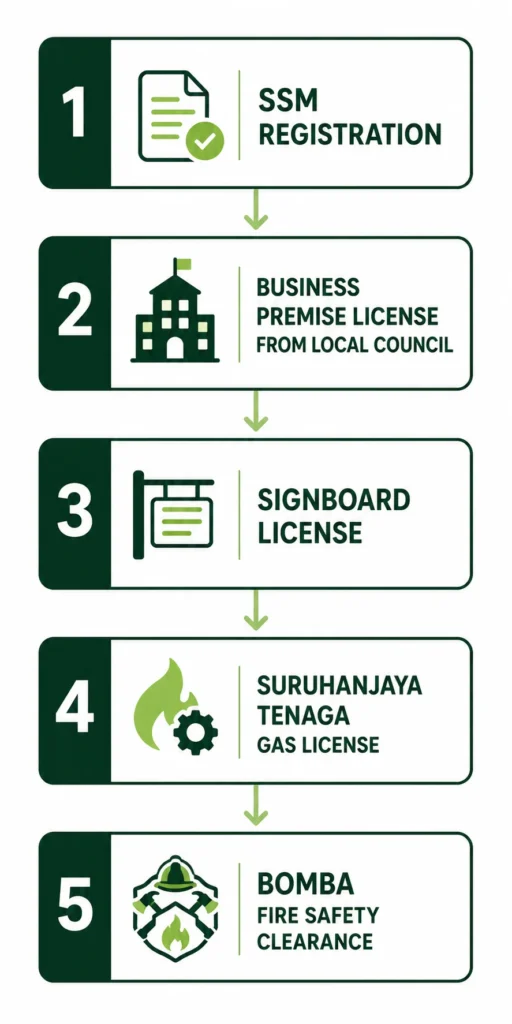
SSM Business Registration
The first step before anything else is registering your business with Suruhanjaya Syarikat Malaysia, which is the Companies Commission of Malaysia. This is the federal-level registration that creates your business as a legal entity.
For a laundromat, you have two main options.
A sole proprietorship is the simplest and cheapest structure. Registration costs between RM30 and RM100 depending on how long the registration name is and whether you use a trade name. You can do this online through the MyCoID portal on the SSM website. The registration is usually processed within one to three working days. The downside of a sole proprietorship is that there is no legal separation between you and your business. If the business has debts or legal problems, your personal assets are at risk.
A private limited company, or Sdn Bhd, costs more to set up, typically around RM1,000 to RM2,000 when you factor in the registration fee, company secretary fees, and the preparation of the memorandum and articles of association. The process takes one to two weeks. The advantage is that your personal liability is limited to your shares in the company. If you are investing RM300,000 or more in a laundromat, the liability protection of a Sdn Bhd is worth considering seriously.
Many laundromat investors in Malaysia who plan to open more than one outlet eventually move toward the Sdn Bhd structure because it makes it easier to take on business partners, apply for larger bank loans, and present a more professional face to landlords and suppliers.
- Cost: RM30 to RM100 for sole proprietorship, RM1,000 to RM2,000 for Sdn Bhd
- Issued by: Suruhanjaya Syarikat Malaysia (SSM)
- Timeline: 1 to 3 working days for sole proprietorship, 1 to 2 weeks for Sdn Bhd
- Apply at: mycoid.ssm.com.my
Business Premise License (Lesen Premis Perniagaan)
This is the license that gives you the legal right to operate your laundromat at a specific address. It is issued by your local municipal council, not by SSM, and it is specific to the location you are renting.
The council that issues your license depends on where your shop is located. In Kuala Lumpur it is DBKL (Dewan Bandaraya Kuala Lumpur). In Petaling Jaya it is MBPJ (Majlis Bandaraya Petaling Jaya). In Shah Alam it is MBSA (Majlis Bandaraya Shah Alam). In Johor Bahru it is MBJB (Majlis Bandaraya Johor Bahru). Every district in Malaysia has its own local authority, and you apply to whichever one covers your shop’s address.
To apply, you will generally need to submit your SSM registration certificate, a stamped tenancy agreement from LHDN, floor plan drawings of your premises, photos of the interior and exterior, and the completed application form from the council.
The Business Premise License is valid for one year and must be renewed annually. Missing a renewal is a legal violation that can result in fines and forced closure.
- Cost: RM300 to RM800 per year depending on the council and the size of your premises
- Issued by: Your local municipal council (DBKL, MBPJ, MBSA, MBJB, etc.)
- Timeline: 2 to 8 weeks depending on the council
- Apply at: Your local council office or their online portal if available
Signboard License (Lesen Papan Tanda)
If you put up any signage on the exterior of your shop, which virtually every laundromat does, you need a Signboard License. This is also issued by your local council and is a separate application from the Business Premise License, although many councils allow you to apply for both at the same time.
The cost depends on the size, type, and number of signs. A standard single illuminated shop sign typically costs between RM200 and RM500 per year. Some councils charge based on the size of the sign in square metres. If you have multiple signs, a large backlit display, or any kind of banner, each may require its own approval.
Some councils are stricter than others about signage. DBKL in Kuala Lumpur, for example, has specific rules about font size, language proportion (Bahasa Malaysia must be at least as prominent as English), and sign dimensions. If you are working with a contractor or branding agency on your signage, make sure they are familiar with the local council’s requirements before producing any materials.
- Cost: RM200 to RM500 per sign per year
- Issued by: Your local municipal council
- Timeline: Applied together with Business Premise License, typically 2 to 6 weeks
- Apply at: Your local council office
Gas License from Suruhanjaya Tenaga
This is the license that most new laundromat investors do not know about until someone tells them, and it is one of the more important ones if your dryers run on gas.
In Malaysia, many commercial laundromats use gas-powered dryers rather than electric dryers because gas is cheaper to run and drying times are faster. If your laundromat uses piped gas for any of your machines, you need a gas license from Suruhanjaya Tenaga, which is the Energy Commission of Malaysia.
The gas installation in your shop must be done by a registered Gas Service Worker. You cannot just hire any plumber or contractor to do the gas piping. The work must be carried out by someone who is officially registered with Suruhanjaya Tenaga as a Gas Service Worker, and the completed installation must be inspected and tested before the license is issued.
After the initial installation, a pressure test is required. The gas system then needs to be re-tested and the license renewed periodically, typically every few years, to remain compliant.
If you are using electric dryers only, you do not need this license. However, you should still ensure that your electrical installation, including the 3-phase power supply, is done by a registered electrical contractor to meet Suruhanjaya Tenaga’s standards.
- Cost: Application fee approximately RM200, plus the cost of hiring a registered Gas Service Worker for the installation
- Issued by: Suruhanjaya Tenaga (Energy Commission of Malaysia)
- Timeline: Typically 1 to 3 weeks after installation is completed and inspected
- Apply at: st.gov.my or through your registered Gas Service Worker
Fire Safety Compliance (BOMBA)
Fire safety is not optional, and BOMBA, which is Jabatan Bomba dan Penyelamat Malaysia, takes it seriously. For most laundromat setups in a standard shophouse unit, the fire safety requirements focus on two things.
The first is fire extinguishers. Every business premises in Malaysia must have fire extinguishers placed at appropriate locations within the shop. Each extinguisher must carry a BOMBA license sticker, which is issued by the local BOMBA station after a BOMBA official inspects the extinguisher. The extinguisher must be serviced annually by an authorised Competent Person, and the license must be renewed each year.
The second is a fire inspection as part of your Business Premise License application. Many local councils require BOMBA clearance before they will issue your Business Premise License. This means a BOMBA officer will visit your premises, check that fire extinguishers are properly placed and licensed, that emergency exits are clear and accessible, that there are no obvious fire hazards, and that fire safety signage is in place.
For small retail shophouse units, a formal Fire Certificate from BOMBA is generally not required. Fire Certificates are mandated for larger designated premises such as shopping malls, hospitals, and buildings above a certain size. A standard laundromat in a ground-floor shophouse unit will typically need fire extinguisher licenses and a BOMBA inspection clearance as part of the council licensing process, but not a formal Fire Certificate.
That said, requirements can vary by state and by council. Always check with your local council and your nearest BOMBA station to confirm exactly what is required for your specific premises.
- Cost: RM150 to RM400 for fire extinguishers and annual servicing, plus the BOMBA license sticker fee
- Issued by: Jabatan Bomba dan Penyelamat Malaysia (BOMBA)
- Timeline: Inspection can usually be arranged within 1 to 2 weeks once your premises are ready
- Apply at: Your nearest BOMBA district office
SST Registration (If Applicable)
Sales and Service Tax, known as SST, registration is only required if your annual revenue exceeds RM500,000. For most single-outlet laundromats, especially in the first few years of operation, this threshold is unlikely to be reached.
If your business does grow to the point where your annual turnover crosses RM500,000, you are required by law to register for SST with the Inland Revenue Board of Malaysia. At that point, you would charge SST on your services and file regular SST returns.
For most new laundromat investors reading this guide, SST is not an immediate concern. But it is worth knowing the threshold so you are prepared if your business grows.
- Cost: No registration fee, but requires ongoing compliance and filing
- Issued by: Royal Malaysian Customs Department (RMCD)
- Threshold: Annual revenue exceeding RM500,000
EPF, SOCSO, and HRDF Registration (If You Have Staff)
If you hire any employees for your laundromat, whether full-time or part-time, you are legally required to register with the Employees Provident Fund (EPF), the Social Security Organisation (SOCSO), and potentially the Human Resources Development Fund (HRDF).
Many self-service laundromats operate without full-time staff, particularly smaller outlets with reliable machines and cashless payment systems. If this is your model, these registrations are not required. But if you have an attendant, a cleaner, or any paid worker, these registrations are mandatory from their first day of employment.
- EPF: Both employer and employee contribute a percentage of the monthly salary to the employee’s retirement fund
- SOCSO: Provides social security protection for employees, covering work injuries and disability
- HRDF: Applies to companies in certain industries with ten or more Malaysian employees
Documents You Will Need for the Full Application Process
Having these documents ready before you start any application will make the process much faster:
- SSM registration certificate or Sdn Bhd incorporation documents
- Stamped tenancy agreement (stamped by LHDN, not just signed)
- Floor plan drawing of your premises showing machine placement, exits, and utilities
- Photographs of the interior and exterior of your premises
- Identity card copies (MyKad) for all directors or business owners
- Building plan approval documents (usually held by your landlord)
- Gas installation certificate from your registered Gas Service Worker (if using gas dryers)

Some councils may ask for additional documents. Always call ahead to your local council office to confirm exactly what their current checklist requires before submitting anything.
A Realistic Timeline from Signing Your Lease to Opening Day
Here is how the licensing timeline typically looks when everything goes smoothly:
| Stage | What Happens | Time Required |
|---|---|---|
| Week 1 | SSM registration completed | 1 to 3 working days |
| Week 1 to 2 | Tenancy agreement stamped at LHDN | 3 to 7 working days |
| Week 2 | Business Premise License application submitted | 1 day to prepare and submit |
| Week 2 to 10 | Council processes Business Premise License | 2 to 8 weeks depending on council |
| Week 3 onwards | Renovation and fit-out begins | 3 to 6 weeks |
| Week 4 to 6 | Gas installation completed by registered Gas Service Worker | During renovation |
| Week 5 to 7 | Suruhanjaya Tenaga gas license application | 1 to 3 weeks after installation |
| Week 6 to 8 | BOMBA fire extinguisher inspection and licensing | 1 to 2 weeks |
| Week 8 to 10 | Final council inspection and Business Premise License issued | Subject to council queue |
| Week 10 to 12 | All licenses received, machines installed and tested | 1 week commissioning |
The council approval process is the biggest variable. Some councils in well-resourced areas like Petaling Jaya or Shah Alam can process applications in two to three weeks. Others may take six to eight weeks, particularly if there is a backlog or if they require multiple site inspections. Starting your license applications as early as possible, even before your renovation is fully complete, will help reduce the overall waiting time.
What Happens If You Open Without the Right Licenses
Operating a laundromat without a valid Business Premise License is an offence under local authority by-laws in Malaysia. If your local council discovers that you are operating without a license, they can issue a compound fine, which typically ranges from RM500 to RM5,000 depending on the council and how long you have been operating without approval. In more serious cases, they can order your premises to be sealed shut until you comply.
Beyond the legal risk, operating without proper licenses also creates problems with your landlord. Most commercial tenancy agreements in Malaysia include a clause requiring tenants to obtain all necessary permits and operate in compliance with local laws. Violating this clause could give your landlord grounds to terminate your lease.
It is also worth noting that if you ever want to sell your laundromat business in the future, a buyer will want to see that all licenses are in order. A business with clean compliance records is much easier to value and transfer than one with a history of operating without proper approvals.
Getting Help with the Licensing Process
The licensing process in Malaysia is manageable if you follow the steps in order and allow enough time. The most common problems we see are investors who start renovation before their tenancy agreement is stamped, who submit incomplete documents to the council and have to resubmit, or who do not realise they need a gas license until after their machines are already installed.
If you want to avoid these delays and make sure your setup runs on schedule from day one, our Business Consultancy for Laundromat Investors service includes guidance on the full licensing process as part of our setup support. We can also connect you with the right contractors for gas installation and electrical work who are registered with the relevant authorities.
If you are still at the planning stage and want to understand the full picture before committing to a location or a lease, talk to our team on WhatsApp and we will walk you through what applies to your specific situation.
Full Licensing Checklist for a Malaysian Laundromat
Use this as your reference before and during your setup process.
Before renovation starts:
- SSM business registration completed
- Tenancy agreement signed and stamped by LHDN
- Business Premise License application submitted to local council
- Signboard License application submitted (usually together with Business Premise License)
- Registered contractor confirmed for gas installation and electrical work
During renovation:
- Gas piping installed by registered Gas Service Worker
- 3-phase electrical installation completed by registered electrical contractor
- Floor plan confirmed with clear emergency exit markings
- Fire extinguisher positions identified and marked on floor plan
Before opening:
- Suruhanjaya Tenaga gas license received
- BOMBA fire extinguisher inspection completed and licenses affixed
- Business Premise License received from local council
- Signboard License received and signage installed
- BOMBA inspection clearance confirmed
- EPF and SOCSO registrations completed if you have staff
Ongoing after opening:
- Business Premise License renewed annually
- Signboard License renewed annually
- Fire extinguishers serviced annually and BOMBA licenses renewed
- Gas system re-inspected per Suruhanjaya Tenaga schedule
- SST registration if annual revenue crosses RM500,000
Frequently Asked Questions
Do I need a halal certification for my laundromat in Malaysia?
Halal certification is not a mandatory legal requirement for operating a self-service laundromat in Malaysia. However, some operators choose to obtain it voluntarily as a marketing point, particularly in areas with a predominantly Muslim customer base. The certification from Jabatan Kemajuan Islam Malaysia (JAKIM) assures customers that the machines and detergents used are halal-compliant. Whether it is worth pursuing depends on your target market and location.
Can I start operating while waiting for my Business Premise License?
Technically, you are not supposed to open to the public before your Business Premise License is issued. In practice, many businesses do open before the license arrives, but this carries legal risk. If a council officer visits during this period, you could receive a compound fine. The safer approach is to time your opening for after the license is confirmed, even if this means some delay.
How long does SSM registration take?
A sole proprietorship registration through the SSM online portal typically takes one to three working days. A Sdn Bhd incorporation takes longer, usually one to two weeks, because it involves more documentation including the preparation and submission of the company’s memorandum and articles of association.
What is the difference between the Business Premise License and the SSM registration certificate?
SSM registration gives your business a legal identity at the federal level. The Business Premise License, issued by your local council, gives you the legal right to operate at a specific address. You need both. One does not replace the other.
Do I need a separate license for each machine?
No. Your Business Premise License covers the entire operation at your premises. Individual machines do not require their own licenses. However, if you use gas-powered dryers, the gas installation as a whole requires a license from Suruhanjaya Tenaga, not per machine but per premises.
What happens if I change my signage after getting the Signboard License?
If you make significant changes to your signage, such as changing the size, adding new signs, or changing the design substantially, you should notify your local council and apply for a new or amended Signboard License. Operating with a sign that does not match your licensed design can result in a fine.