


Laundromat Business Plan Template for Malaysia Investors
If you are planning to open a laundromat in Malaysia, you need a business plan. Not because someone told you to write one, but because the process of building it forces you to answer questions that most new investors avoid until they have already made expensive mistakes.
How much revenue will you realistically earn in month one versus month twelve? What is your monthly break-even point? Can you survive three months of lower-than-expected footfall without running out of cash?
A business plan answers all of these questions before you spend a single Ringgit on renovation or machines. It also happens to be the document a bank loan officer or any outside investor will ask for first.
This guide gives you a complete laundromat business plan structure for Malaysia, with real RM figures, a worked financial example for a small laundromat, and a three-year projection table you can adapt for your own setup.
No competitor in Malaysia has published a template with actual numbers. This is it.
What a Laundromat Business Plan Needs to Include
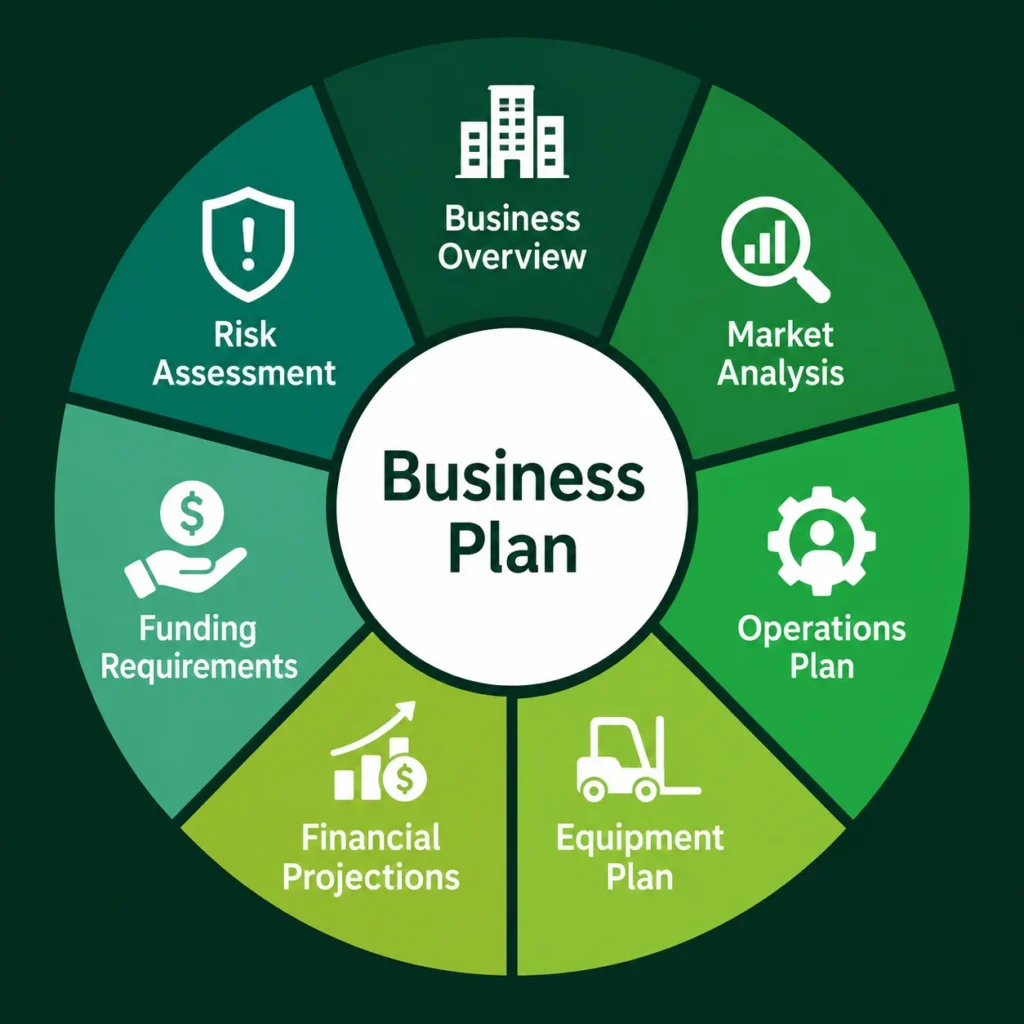
A laundromat business plan does not need to be a 50-page academic document. A practical, investor-ready plan has seven sections. Each one answers a specific question that a bank, investor, or even just your future self needs to be able to answer with confidence.
The seven sections are:
- Business overview
- Market analysis
- Operations plan
- Machine and equipment plan
- Financial projections
- Funding requirements
- Risk assessment
We will go through each one, and at the end you will find a complete worked example using a real Malaysian laundromat scenario.

Section 1: Business Overview
This section introduces your laundromat and explains the basics of what you are building. Keep it short and factual. One to two pages is enough.
Business name and legal structure. State the name of your business and whether it is registered as a sole proprietorship or Sdn Bhd. If you have not registered yet, state which structure you plan to use.
Location. The address or at least the area where you plan to operate, such as Cheras, Kuala Lumpur or Skudai, Johor Bahru. If you have not signed a lease yet, describe the type of location you are targeting, for example a ground-floor shophouse unit adjacent to a residential apartment cluster.
Business concept. One or two sentences explaining the type of laundromat you are opening. For example: a 24-hour self-service laundromat with 12 machines, coin and cashless payment options, serving the rental apartment community near your chosen location.
Mission statement. A single sentence about what your laundromat is there to do. Keep it simple, for example: to provide reliable, affordable, and clean self-service laundry to residents of your area.
Objectives. Two or three specific goals for the first year, such as reaching 50 percent machine utilisation by month six, recovering RM80,000 in revenue in year one, or opening a second outlet by year three.
Section 2: Market Analysis
This section proves that there is genuine demand for your laundromat at your chosen location. It is the section that separates investors who have done their homework from those who are guessing.
Malaysia laundry market overview. The self-service laundry industry in Malaysia has grown consistently over the past decade. Urbanisation, smaller living spaces in cities, and a growing renter population have all contributed to rising demand. More Malaysians are now living in apartments and condominiums that either have no in-unit washing facilities or provide only small capacity shared machines. This creates a steady, recurring customer base for well-located laundromats.
Your target customer. Describe who your customers will be. The most common customer groups for Malaysian laundromats are:
- Young working adults aged 22 to 35 living in rental apartments or rooms
- University and college students in hostel or off-campus accommodation
- Factory and industrial workers in budget hostel housing
- Families in high-rise apartments who need to wash large items like comforters and curtains
Be specific about which group you are primarily targeting. A laundromat near a university campus serves a different customer than one in an industrial worker accommodation area, even if both are profitable models.
Local demand assessment. Describe the residential landscape within 1 to 2 kilometres of your site. How many apartment blocks or rented rooms are within walking distance? What is the estimated renter population? Are there any demand indicators such as existing laundromats that are always busy during peak hours?
Competitive analysis. Name the existing laundromats within your catchment area. For each one, note the number of machines, approximate age and condition, payment methods, opening hours, and any obvious weaknesses. Explain how your laundromat will be different or better.
Section 3: Operations Plan
The operations plan explains how your laundromat will run on a day-to-day basis. This is important for investors and banks because it shows you have thought through the practical reality, not just the financial model.
Operating hours. Most Malaysian laundromats operate 24 hours or from 6am to midnight. State your planned hours and explain your reasoning. 24-hour operation generates more revenue but requires better security, reliable machines, and possibly a monitoring system or attendant for late-night hours.
Staffing model. Self-service laundromats in Malaysia typically operate with minimal staff. Many small laundromats run entirely without a full-time attendant, relying on the owner to visit daily for cleaning, coin collection, and basic maintenance checks. Others hire a part-time attendant for peak hours. State your planned staffing approach and what it will cost monthly.
Maintenance plan. Describe how machines will be maintained. This includes a daily cleaning routine, a schedule for monthly basic servicing such as filter cleaning and drum inspection, and a plan for calling in professional technicians for mechanical issues. Machines that break down regularly damage your reputation and reduce revenue. A maintenance plan shows investors you are taking the long-term performance of your equipment seriously.
Customer experience. Briefly describe what your shop will offer beyond machines. This might include folding tables and seating, a coin change machine or cashless payment kiosks, a vending machine for detergent sachets, CCTV for security, and good lighting throughout. These details matter to customers and differentiate a well-run laundromat from a neglected one.
Section 4: Machine and Equipment Plan
Banks and investors want to know exactly what they are funding. List your equipment specifically, not just in general terms.
A typical small Malaysian laundromat equipment plan might look like this:
| Equipment | Quantity | Unit Cost (RM) | Total Cost (RM) |
|---|---|---|---|
| 10 kg commercial washer | 3 units | 5,500 | 16,500 |
| 14 kg commercial washer | 4 units | 8,500 | 34,000 |
| 20 kg commercial washer | 1 unit | 14,000 | 14,000 |
| 14 kg commercial dryer | 4 units | 7,000 | 28,000 |
| 20 kg commercial dryer | 2 units | 11,000 | 22,000 |
| Coin payment system (per machine) | 14 units | 1,000 | 14,000 |
| Cashless payment kiosk | 1 unit | 8,000 | 8,000 |
| Detergent vending machine | 1 unit | 3,500 | 3,500 |
| CCTV system (4 cameras) | 1 set | 2,500 | 2,500 |
| Total equipment cost | RM142,500 |
Include the brand names of the machines you plan to purchase if you have already decided. Reputable commercial machine brands demonstrate to investors and banks that you are not trying to cut costs with domestic-grade equipment that will break down under commercial usage.
Also note your machine warranty terms and which supplier you are purchasing from. If your supplier includes installation and commissioning in the price, state that clearly, as it affects your total setup cost estimate.
Section 5: Financial Projections
This is the most important section of your business plan. It is also the section most Malaysian laundromat investors get wrong because they either use figures that are too optimistic, borrow numbers from overseas markets, or leave it out entirely because it feels too complicated.
We will walk through a realistic set of projections for a small Malaysian laundromat so you can see how the numbers are built.
The Example Setup
For this worked example, we will use a small laundromat in a residential area of Selangor with the following parameters:
- 14 machines total: 8 washers and 6 dryers
- Shop size: approximately 500 square feet
- Monthly rent: RM2,500
- Operating hours: 7am to midnight daily (17 hours)
- Pricing: RM5 per wash cycle, RM4 per dry cycle
- Total startup investment: RM280,000
Monthly Revenue Projection
Revenue is calculated based on machine count, cycles per machine per day, and price per cycle.
| Machine Type | Qty | Cycles Per Day (Realistic) | Price Per Cycle | Daily Revenue |
|---|---|---|---|---|
| Washers | 8 | 6 cycles each | RM5.00 | RM240 |
| Dryers | 6 | 7 cycles each | RM4.00 | RM168 |
| Daily total | RM408 |
Note: 6 to 7 cycles per machine per day is a conservative estimate based on Malaysian laundromat operating experience. A busy laundromat with good footfall can run 8 to 12 cycles per machine per day during peak months.
| Period | Daily Revenue | Monthly Revenue |
|---|---|---|
| Months 1 to 3 (ramp-up, approximately 40% utilisation) | RM163 | RM4,900 |
| Months 4 to 6 (building, approximately 55% utilisation) | RM224 | RM6,720 |
| Months 7 to 12 (established, approximately 70% utilisation) | RM286 | RM8,580 |
| Year 2 average (approximately 80% utilisation) | RM326 | RM9,800 |
| Year 3 average (approximately 85% utilisation) | RM347 | RM10,400 |
Monthly Operating Expenses
| Expense Item | Monthly Cost (RM) |
|---|---|
| Shop rent | 2,500 |
| Electricity (machines, lighting, aircon) | 1,800 |
| Water | 600 |
| Gas (dryers, if applicable) | 500 |
| Machine maintenance and minor repairs | 400 |
| Cleaning supplies and consumables | 200 |
| Business insurance | 150 |
| License renewals (monthly allocation) | 50 |
| Marketing (Google, WhatsApp, flyers) | 300 |
| Miscellaneous | 200 |
| Total monthly expenses | RM6,700 |
Note: Utilities, particularly electricity, are typically the largest variable cost for a Malaysian laundromat. A good rule of thumb is that electricity and water combined should not exceed 30 to 35 percent of your monthly revenue at healthy utilisation levels. If your utility bill is eating more than this, your pricing may need to be reviewed or your machines may not be energy-efficient enough.
Monthly Profit and Loss Summary
| Month Range | Revenue | Expenses | Net Profit (Loss) |
|---|---|---|---|
| Months 1 to 3 | RM4,900 | RM6,700 | (RM1,800) |
| Months 4 to 6 | RM6,720 | RM6,700 | RM20 |
| Months 7 to 12 | RM8,580 | RM6,700 | RM1,880 |
| Year 2 average per month | RM9,800 | RM6,900 | RM2,900 |
| Year 3 average per month | RM10,400 | RM7,100 | RM3,300 |
In this example, the laundromat reaches monthly operational break-even somewhere between months four and six. This is realistic for a well-located Malaysian laundromat with a proper fit-out and a consistent maintenance standard.
Three-Year Financial Summary
| Year 1 | Year 2 | Year 3 | |
|---|---|---|---|
| Total revenue | RM82,500 | RM117,600 | RM124,800 |
| Total operating expenses | RM80,400 | RM82,800 | RM85,200 |
| Net operating profit | RM2,100 | RM34,800 | RM39,600 |
| Cumulative profit | RM2,100 | RM36,900 | RM76,500 |
| Investment recovered | 0.75% | 13.2% | 27.3% |
At this rate, the full RM280,000 investment is on track for recovery within approximately 3.5 to 4 years. This is consistent with what we see across our clients’ laundromats in Malaysia when they are properly located and managed.
Sensitivity Note for Your Own Plan
When you build your own projections, do not use your best-case numbers as your base case. Use your realistic estimate of utilisation at months three and six, and make sure your plan shows you can survive those early months on your working capital buffer without going into additional debt.
The numbers above assume the laundromat is open seven days a week. If your area has noticeably slower weekdays, adjust accordingly. If your rent is higher than RM2,500 or your machine count is different, update each line individually.
Section 6: Funding Requirements
If you are seeking outside funding, whether from a bank or a government scheme, this section tells the reader exactly how much money you need, what it will be used for, and how you plan to repay it.
Total investment required. State the complete startup cost including renovation, machines, licenses, deposits, marketing, and working capital. In the example above this is RM280,000.
Own contribution. State how much you are funding yourself. Most Malaysian banks require you to fund at least 20 to 30 percent of the total investment from your own pocket before they will approve a loan for the remainder.
Loan amount requested. The difference between your total investment and your own contribution.
Repayment plan. Show how the monthly loan repayment fits into your projected cash flow. If you are borrowing RM200,000 over five years at a 6 percent annual interest rate, your monthly repayment is approximately RM3,867. Add this to your monthly expenses table and show that your projected revenue still leaves you with positive cash flow once the loan is repaid.
A table like this makes it easy for a loan officer to see the picture at a glance:
| Item | Amount (RM) |
|---|---|
| Total startup investment | 280,000 |
| Investor’s own contribution (30%) | 84,000 |
| Bank loan requested | 196,000 |
| Loan term | 5 years |
| Estimated monthly repayment | 3,790 |
| Revenue needed to cover all costs including repayment | 10,490 |
| Projected monthly revenue by month 12 | 8,580 |
| Projected monthly revenue by year 2 | 9,800 |
In this example, full loan coverage from monthly revenue is achieved around the middle of year two, which is a realistic and credible timeline for a bank.
If you are applying for a government scheme such as TEKUN, PUNB, or SME Bank’s Biz Mula-i, ask the officer at the agency what specific financial information they require. Different programmes have their own documentation checklists, but most will expect at least the startup cost breakdown, the monthly cash flow projection, and your own contribution amount.
Our Finance Advisory for Laundry Startups service can help you prepare the right documents for your specific funding path.
Section 7: Risk Assessment
Every business plan needs to address what could go wrong and what you will do about it. This section does not need to be long. It just needs to show that you have thought through the main risks honestly.
Risk 1: Lower-than-expected footfall in early months. This is the most common early-stage risk. Your mitigation is a working capital buffer that covers at least three to four months of operating expenses at zero revenue. Budget for this before you commit to a location.
Risk 2: Machine breakdown. A machine that is out of service costs you revenue and damages customer trust. Your mitigation is buying commercial-grade machines from a reputable supplier with a warranty and spare parts availability, combined with a regular maintenance schedule. Avoid the temptation to buy cheaper machines that are not designed for commercial cycle volumes.
Risk 3: Competition opening nearby. A new laundromat within your catchment area will reduce your customer base. Your mitigation is to build customer loyalty early through cleanliness, reliable machines, fair pricing, and a Google Maps presence with positive reviews. Customers who trust your shop are much harder to pull away than new customers who have not yet formed a habit.
Risk 4: Utility cost increases. TNB electricity tariff changes and water rate adjustments affect your margins. Your mitigation is to choose energy-efficient machines and to monitor your utility costs as a percentage of monthly revenue. If costs rise significantly, you have the option to adjust your pricing to compensate.
Risk 5: Landlord issues. A landlord who terminates your lease early or raises rent dramatically after year one can seriously disrupt your business. Your mitigation is to negotiate a tenancy agreement of at least two to three years with clear renewal terms and a capped annual rent increase clause before you spend any money on renovation.
How to Use This Template
Take the seven sections above and fill them in based on your own situation. Replace every figure in the worked example with your actual numbers: your machine count, your rent, your target location, your utilisation estimate.
If you are presenting this plan to a bank, print it cleanly with a cover page and a one-page executive summary at the front that gives the key numbers: total investment, loan amount, projected break-even timeline, and expected revenue in year one and year two.
If you are using this plan for your own decision-making rather than for a bank, the most valuable part is the monthly cash flow table. Fill it in honestly and ask yourself whether you are comfortable with the outcome in the worst-case scenario, not just the best case.
A business plan that has been built with real numbers from a specific site and a specific machine configuration is worth ten generic templates downloaded from the internet. The value is in the thinking you do while building it, not just the document itself.
If you want help building your financial model based on your specific location and setup, our Business Consultancy for Laundromat Investors service works through this process with you directly.
Talk to our team on WhatsApp and we can help you build a plan that reflects your actual investment, your chosen location, and the realistic revenue you can expect.
Frequently Asked Questions
Do I really need a business plan to open a laundromat in Malaysia?
If you are funding the entire setup yourself and you have already made up your mind, a formal plan is not legally required. But it is still a valuable exercise because it forces you to confront the numbers honestly before you commit. If you are applying for any kind of bank loan or government funding, a written business plan is always required.
What is a realistic first-year revenue target for a small Malaysian laundromat?
For a small laundromat with 10 to 14 machines in a good residential location in Selangor or KL, a realistic first-year revenue target is between RM70,000 and RM100,000. This assumes a gradual ramp-up from low utilisation in the first two months to around 60 to 70 percent utilisation by month six. Laundromats in slower locations or with fewer machines will be at the lower end. Well-located laundromats near high-density apartment clusters can exceed RM100,000 in year one.
How do I estimate machine utilisation for my projections?
Start with a conservative estimate of 40 percent utilisation in month one. This means each machine runs about 40 percent of the cycles it theoretically could in your operating hours. Build this up gradually in your projections to 60 to 70 percent by month six and 75 to 80 percent by the end of year one for a good location. Avoid using 90 or 100 percent utilisation in your projections. No laundromat runs at full capacity consistently, and building your plan on those numbers sets you up for a cash shortfall in reality.
What should my gross profit margin look like?
A well-run Malaysian laundromat with modern machines should achieve a gross profit margin of 25 to 35 percent after paying all operating expenses but before deducting loan repayments or depreciation. If your margin is below 20 percent, your rent or utility costs are likely too high relative to your revenue and either your pricing or your location needs to be revisited.
Can I write my own business plan or do I need to hire someone?
You can absolutely write it yourself using the template in this guide. The key is to use your own real numbers rather than copying generic figures. If you are applying for a significant bank loan, having a finance professional review the numbers and present them clearly is helpful because loan officers respond better to clean, well-formatted financial statements than to handwritten notes or rough estimates.
How far ahead should my financial projections go?
A three-year projection is standard for a bank loan application. Year one shows your ramp-up period. Year two shows your stabilised operational performance. Year three demonstrates that the business has growth potential beyond just covering its costs. For your own planning purposes, building a five-year model is useful if you are thinking about opening a second outlet.