


How to Choose the Best Location for Your Laundromat in Malaysia
Ask any experienced laundromat operator what the number one reason laundromats fail is, and most will give you the same answer: wrong location.
You can have the best machines, the cleanest shop, and the fairest prices in your area. If the location does not have the right mix of people, accessibility, and demand, none of that will matter. Customers simply will not come in the numbers you need to cover your costs.
At Launch Laundry, location assessment is one of the first things we work through with every client before they commit to anything. After helping set up over 500 laundromats across Malaysia, we have seen what works and what does not, across cities, towns, and different types of neighbourhoods.
This guide gives you a practical framework for choosing a laundromat location in Malaysia, from the five criteria that matter most to a city-by-city breakdown and the red flags that should stop you from signing a lease.
Why Location Matters More for a Laundromat Than Most Businesses
A laundromat is a walk-in business. Unlike an online shop or a business that can market itself to a wide area, your customer base is almost entirely made up of people who live or work within 1 to 3 kilometres of your shop. If those people do not need your service, are too far to bother walking, or cannot park near you, your revenue will be low no matter how well you run everything else.
This is different from, say, a restaurant or a barbershop where a loyal customer might drive 20 minutes because the food or service is exceptional. Nobody drives 20 minutes to use a coin laundry when there are other options closer to home. The convenience of the location is often the product itself.
This is also why a laundromat that is poorly located cannot usually be fixed with better marketing or lower prices. You can delay the problem, but you cannot solve it. The only real fix is a better location, which means either moving or opening a second outlet somewhere else.
Getting the location right from the beginning is not just important. It is the decision that everything else rests on.
The 5 Criteria That Determine a Good Laundromat Location
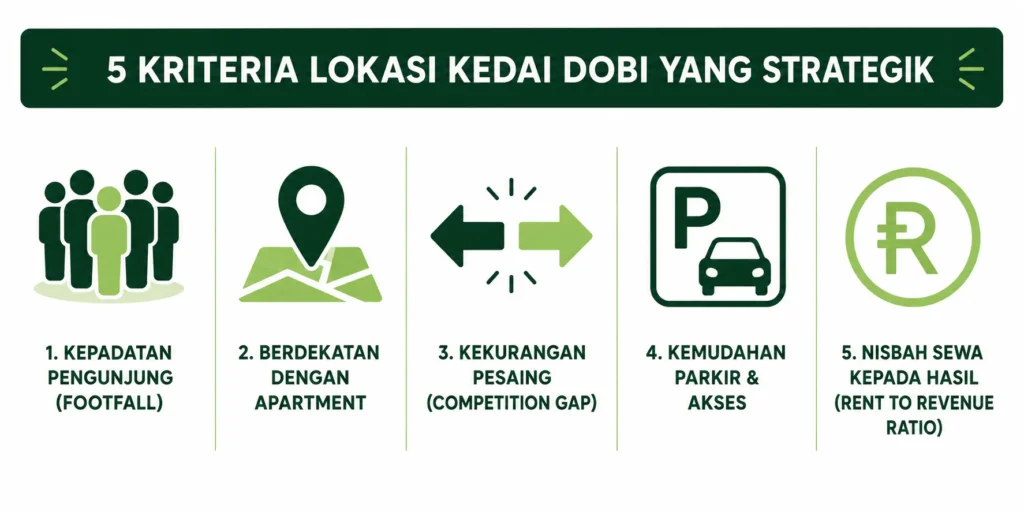
When we assess a potential location for a new laundromat in Malaysia, we look at five things.
1. The Right Kind of People Living Nearby
Not every residential area is a good market for a laundromat, even if the population is dense. The type of housing matters a great deal.
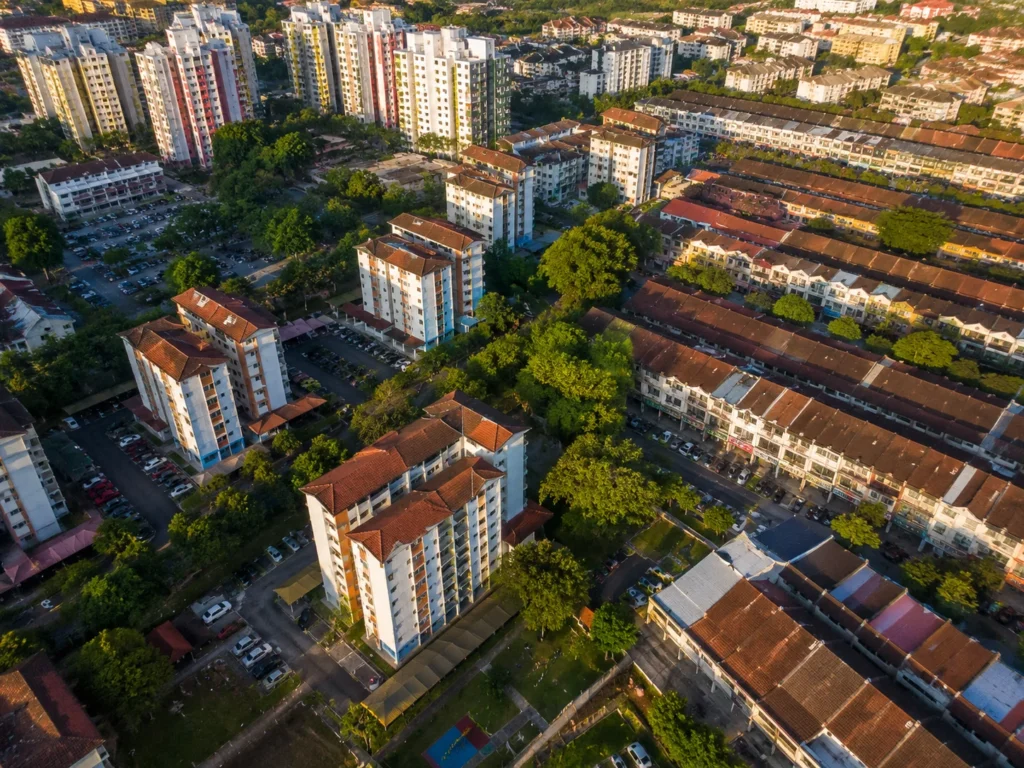
The best customers for a self-service laundromat are renters living in apartments, condominiums, budget rooms, or hostels. These are people who either do not have a washing machine at home or whose machine is too small for heavy loads like comforters and blankets. They have a genuine need for your service at least once or twice a week.
Homeowners in landed properties, on the other hand, almost always own their own washing machine. A neighbourhood of double-storey terraces in a mature suburb is generally not a great laundromat market, even if the population density looks good on paper.
Look for areas with a high proportion of renters. In Malaysia, this typically means areas near high-rise apartments, worker accommodation, university student housing, factory workers quarters, and budget lodging for migrant workers. These groups have strong, consistent demand for laundromat services.
A useful rule of thumb is that if you can see multiple apartment blocks or rows of budget rooms within a 10-minute walk of the site, the residential mix is probably right. If you see mainly single-family landed homes, keep looking.
2. Genuine Footfall, Not Just Traffic Volume
Footfall and traffic are not the same thing. A busy road with thousands of cars passing every day does not guarantee that people will stop at your laundromat. What you need is pedestrian footfall, meaning people who are already walking past your shop or nearby at times that suit laundry behaviour.
Laundromat usage in Malaysia is highest in the late morning, afternoon, and early evening on weekdays, and throughout the day on weekends. Visit your shortlisted location at these times and count how many people are actually walking nearby. Notice what types of businesses are already operating there and whether they are busy.
Good footfall generators near a laundromat include:
- Convenience stores and minimarkets such as 7-Eleven, KK Super Mart, and MyNews
- Morning markets or pasar malam
- Coffee shops and food stalls that locals visit regularly
- Pharmacies and clinics
- Bus or LRT stations with pedestrian exits
When your laundromat is next to or near a place people already visit regularly, they form a habit of dropping their laundry on the way and picking it up later. That habit is the foundation of consistent repeat business.
3. How Many Competitors Are Already There
Competition is one of the trickiest criteria to judge because having zero competitors in an area is not automatically a good sign.
If there are no laundromats within 2 kilometres of a location, ask yourself why. It might be because you have identified an underserved market and you are the first to spot the opportunity. But it might also be because someone tried before and it did not work, or because the demographics in that area do not actually support laundromat demand.
The ideal competitive situation is finding an area where there is clear demand for laundromat services but existing operators are not serving it well. Signs of this include:
- Existing laundromats that are old, poorly maintained, or operating with very few machines
- Long queues at nearby laundromats during peak hours
- Low-quality machines that break down frequently and frustrate regular customers
- Operators who do not offer cashless payment when the area has a younger, digital-savvy population
If you can offer better machines, a cleaner environment, and more reliable service than what already exists in the area, entering a competitive market is not necessarily a bad thing. Customers will switch to a better option.
Where you want to be careful is entering a market that already has one or two well-run, modern laundromats serving the same customer base. In that situation, you will be competing on price, which erodes your margins, or waiting years for the market to grow enough to support an additional outlet.
To map your competitors properly, search Google Maps for laundromats, dobi, or coin laundry within a 3-kilometre radius of each site you are considering. Visit each one in person during peak hours. Count the machines, check if they are busy, and take note of the condition of the shop and the quality of service.
4. Accessibility and Parking
A laundromat customer typically arrives carrying a heavy bag or basket of laundry. Making that journey inconvenient will cost you customers.
For a laundromat in Malaysia, the ideal accessibility looks like this:
- Ground floor unit with direct street access, no steps or ramps required
- Parking spaces within 50 metres, ideally right in front or adjacent to the shop
- Easy to see from the road, with space for clear signage
- Close to a pedestrian path or walkway for customers who arrive on foot
Upper-floor units are almost never suitable for a laundromat. Customers will not carry laundry up a staircase or wait for a lift if there is a ground-floor option anywhere nearby. Always insist on ground-floor placement.
Parking is particularly important in suburban areas and townships where most customers arrive by car. If the parking is limited, contested, or requires walking a long distance, you will lose customers to whichever competitor has better parking nearby.
In urban areas near LRT or MRT stations, the calculation changes slightly. Customers in these areas often arrive on foot or by public transport, so station proximity matters more than parking. A shop that is a 3-minute walk from a train station exit in Kepong or Cheras can do excellent business even without a dedicated parking lot.
5. Rent Versus Revenue Potential
The final criterion is financial. A brilliant location is worthless if the rent eats up all your profit.
Commercial rental rates in Malaysia vary enormously. A ground-floor shop unit in a prime area of Petaling Jaya or Mont Kiara can cost RM5,000 to RM12,000 per month. The same size unit in a smaller town or a less developed township might cost RM1,500 to RM3,000 per month.
The question is not which location is cheaper. The question is which location gives you the best ratio of revenue potential to rent cost. A shop costing RM5,000 per month in a densely populated urban area might generate RM25,000 in monthly revenue. A shop costing RM2,000 per month in a quiet area might only generate RM8,000. The expensive location could easily be the better business.
As a rough guide, your monthly rent should not exceed 15 to 20 percent of your projected monthly revenue. If the numbers do not work within this range, either the rent is too high for the revenue potential or you need to reconsider the location.
Before signing any lease, work out your projected monthly revenue based on:
- Number of machines
- Estimated cycles per machine per day (a realistic figure is 6 to 10 cycles per machine on a busy day)
- Your pricing per cycle
- An honest estimate of your utilisation rate in the first 3 to 6 months (typically 30 to 50 percent)
If the revenue projection looks healthy against the rent, the location may work. If it looks tight, it probably is tight.
The Best Location Types for Malaysian Laundromats
Beyond individual site criteria, certain types of locations consistently perform well for laundromats in Malaysia. Here are the ones we see succeed most often.
Near high-rise apartment clusters. This is the single most reliable location type in Malaysia. Areas with multiple condominium blocks or apartment towers filled with renters create a dense, consistent customer base. Look for buildings where car parks are tight, units are small, and residents are young working adults or students. Pandan Perdana in KL, Setapak, Klang, Shah Alam Section 7 and 13, and similar high-density residential areas are strong examples of this type.
Near universities and colleges. Students are among the most loyal and frequent laundromat customers. They often live in small rooms with no washing machine, they do laundry on a tight budget, and once they find a reliable laundromat near campus, they come back every week. Areas near UTAR Sungai Long, UPM Serdang, UITM Shah Alam, Sunway University, and Taylor’s Lakeside are consistently good for laundromat business.
Near factory worker accommodation. Industrial areas where large numbers of workers live in hostels or budget rooms have very high demand for laundromat services. Workers wash large volumes of work clothes frequently, and many have no washing facilities in their accommodation. Areas in Shah Alam, Klang, Senai, Pasir Gudang, and Meru are worth considering if your site is near worker housing clusters.
In commercial strips serving residential townships. A row of shophouses serving a large housing estate can be a good location if the shops are busy and the township is well-populated. The key is that the strip serves daily needs like food, groceries, and pharmacies for a large enough surrounding population to support regular laundromat visits.
Near LRT, MRT, or KTM stations with adjacent apartments. Station-adjacent areas in cities like KL, Selangor, and Penang often combine high-density rental housing with heavy pedestrian footfall. Stations like Kepong Baru, Maluri, Salak Selatan, Setia Jaya, and Batu Caves are surrounded by the kind of renter population that uses laundromats regularly.
City by City Overview
Each major city in Malaysia has its own dynamics. Here is a brief overview based on our experience setting up laundromats across the country.
Kuala Lumpur. The highest-density market in Malaysia. Strong demand across many areas, particularly around Cheras, Kepong, Setapak, Titiwangsa, Wangsa Maju, and Pandan. Competition is significant in some of these areas, so doing proper competitor research before committing is important. Rent is higher than in other cities, which means you need to be precise about revenue projections. Visit our Kuala Lumpur laundromat setup page for more specific guidance on KL opportunities.
Selangor. The most diverse market in Malaysia in terms of location types. You have dense urban areas like Petaling Jaya, Subang Jaya, and Shah Alam, established township corridors in Klang and Rawang, and fast-growing new developments in Puchong, Cyberjaya, and Sepang. Rental rates are generally lower than central KL while population density remains high in many areas. This makes Selangor one of the strongest states for laundromat investment. See our Selangor setup page for more detail.
Johor Bahru. A rapidly growing market driven by cross-border workers, a large student population, and ongoing residential development. Areas near Skudai, Kempas, Johor Jaya, and Plentong have strong renter populations. Iskandar Malaysia developments continue to bring new residents to the area. Rental rates are still reasonable compared to KL, which gives JB-based laundromats a favourable cost-to-revenue ratio. Our Johor Bahru page covers this market in more depth.
Penang. A strong market on the island side, particularly in areas around USM and the Georgetown affordable housing clusters. The mainland side in Seberang Perai is growing quickly and offers lower rents with a large working population. Penang’s tourism sector also brings transient demand in certain areas. See our Penang setup page.
Melaka. A smaller market but with consistent demand near UTeM, MMU Melaka, and the areas around Ayer Keroh and Cheng. Competition is lighter than in KL or JB, which gives new entrants more room. Our Melaka page has more detail on the specific areas we recommend there.
Sabah and Sarawak. Both states have growing urban populations in Kota Kinabalu, Sandakan, Kuching, and Sibu. Laundromat penetration is lower than in Peninsular Malaysia, which means less competition and a real opportunity for first movers in well-chosen spots. Read more on our Sabah and Sarawak page.
How to Do Your Own Competitor Mapping in 4 Steps
You do not need expensive software to do a solid competitor assessment before choosing a location. Here is a simple process that works.
Step one: Open Google Maps and search for dobi, coin laundry, laundromat, and self-service laundry in the area around each site you are considering. Mark all results within a 3-kilometre radius.
Step two: Visit each competitor in person. Go during peak hours on a weekday afternoon and on a Saturday morning. Count the number of machines. Count how many are in use. Check how old and well-maintained the machines are. Note whether they accept cashless payment. Observe whether the shop is clean and whether there is an attendant or any form of customer service.
Step three: Read their Google reviews. Sort by newest and look for recurring complaints. Common ones include machines breaking down, poor ventilation, limited machine sizes, or no change machine. These are gaps you can address.
Step four: Calculate the demand gap. If you see a cluster of 5,000 residents within a 2-kilometre radius and only one ageing laundromat with 10 machines that is always busy, there is likely room for a new, well-equipped outlet. If there are already three modern laundromats in the same area, the market may already be at capacity.
Red Flags to Avoid
These are the location warning signs that should make you pause before committing.
A shop on the first floor or higher. Customers will not carry laundry upstairs if there is any alternative. This is a hard rule for laundromats.
A location where the surrounding buildings are mainly owned homes. If the residential density around the site is mostly landed property, the demand for your service will be too low to sustain a business.
Landlords who refuse to let you check the electrical capacity before signing. A laundromat needs 3-phase power and adequate amperage. If the landlord is evasive about this, you could end up with a shop that requires expensive electrical upgrades before you can even install machines.
Weak pedestrian movement at the times you visit. If the area feels quiet when you go during lunch or after 5pm on a weekday, it is quiet during your most important trading hours. Do not assume it will improve once you open.
A rental price that only works if you achieve near-full machine utilisation from day one. New laundromats typically operate at 30 to 50 percent utilisation in the first few months while building a customer base. If your rent requires 80 percent utilisation just to break even, the financial risk is very high.
A location with a new laundromat already under construction nearby. This is something you need to check physically, not just on Google Maps. A competitor opening 3 months after you will hurt your early growth significantly.
Getting Location Assessment Right from the Start
Choosing a location is not something to rush, and it is not something to do based on gut feeling alone. The best laundromat investors we work with spend weeks shortlisting and evaluating locations before signing anything. They visit multiple times at different times of day and different days of the week. They talk to nearby businesses. They count the apartment blocks. They check the competitor quality. They run the rent-versus-revenue numbers honestly.
If you want a professional assessment before you commit, our Research Planning for Laundry Businesses service takes you through a structured site evaluation process. We use our experience from 500-plus setups across Malaysia to help you avoid costly mistakes and confirm the locations that make financial sense.
Getting the location right is the single most important thing you can do before spending any money on renovation or machines. Everything else can be improved over time. The location stays fixed.
Ready to evaluate a specific site? Talk to our team on WhatsApp and we can walk you through the next steps.
Frequently Asked Questions
What is the most important factor when choosing a laundromat location in Malaysia?
The most important factor is the type of people living nearby. Areas with a high proportion of renters living in apartments, budget rooms, or student accommodation have the strongest demand for laundromat services. Renters are far more likely to use a laundromat regularly than homeowners who already own a washing machine.
How close should a laundromat be to apartments or housing?
Ideally within a 5 to 10 minute walk of the main residential buildings you want to serve. If customers have to drive to reach you when there are other laundromats closer to them, you will lose those customers. The closer you are to a dense concentration of renters, the better your baseline footfall will be.
Is a busy road a good location for a laundromat in Malaysia?
Road traffic volume alone is not enough. What matters is pedestrian footfall, not cars passing by. A shop on a busy road with no pedestrian pavement, no parking, and no reason for people to stop will struggle. A quieter road inside a residential neighbourhood with a large renter population and easy parking can outperform a roadside unit significantly.
Should I avoid areas with existing laundromats?
Not necessarily. The presence of existing laundromats actually confirms that demand exists. The question is whether those laundromats are serving the market well. If nearby competitors have old machines, poor hygiene, no cashless payment, or long wait times, there is a genuine opportunity to take market share with a better service. The situation to avoid is entering a market that already has multiple well-run, modern laundromats competing for the same customers.
How do I know if the rent is too high for a laundromat location?
A simple test is to estimate your realistic monthly revenue based on your machine count, pricing, and an honest utilisation rate of 30 to 50 percent in the first 3 to 6 months. If your rent costs more than 15 to 20 percent of that revenue figure, the rent is likely too high relative to the opportunity. If the numbers only work at near-full utilisation, the financial risk is too large.
Can a laundromat work in a smaller Malaysian town or secondary city?
Yes, provided the fundamentals are there. Smaller cities like Seremban, Ipoh, Muar, Kluang, Sibu, and Sandakan have growing renter populations and lower competition than the main urban centres. The rent is lower too, which can make the financial model work very well if you choose a location with the right residential mix near your shop.