


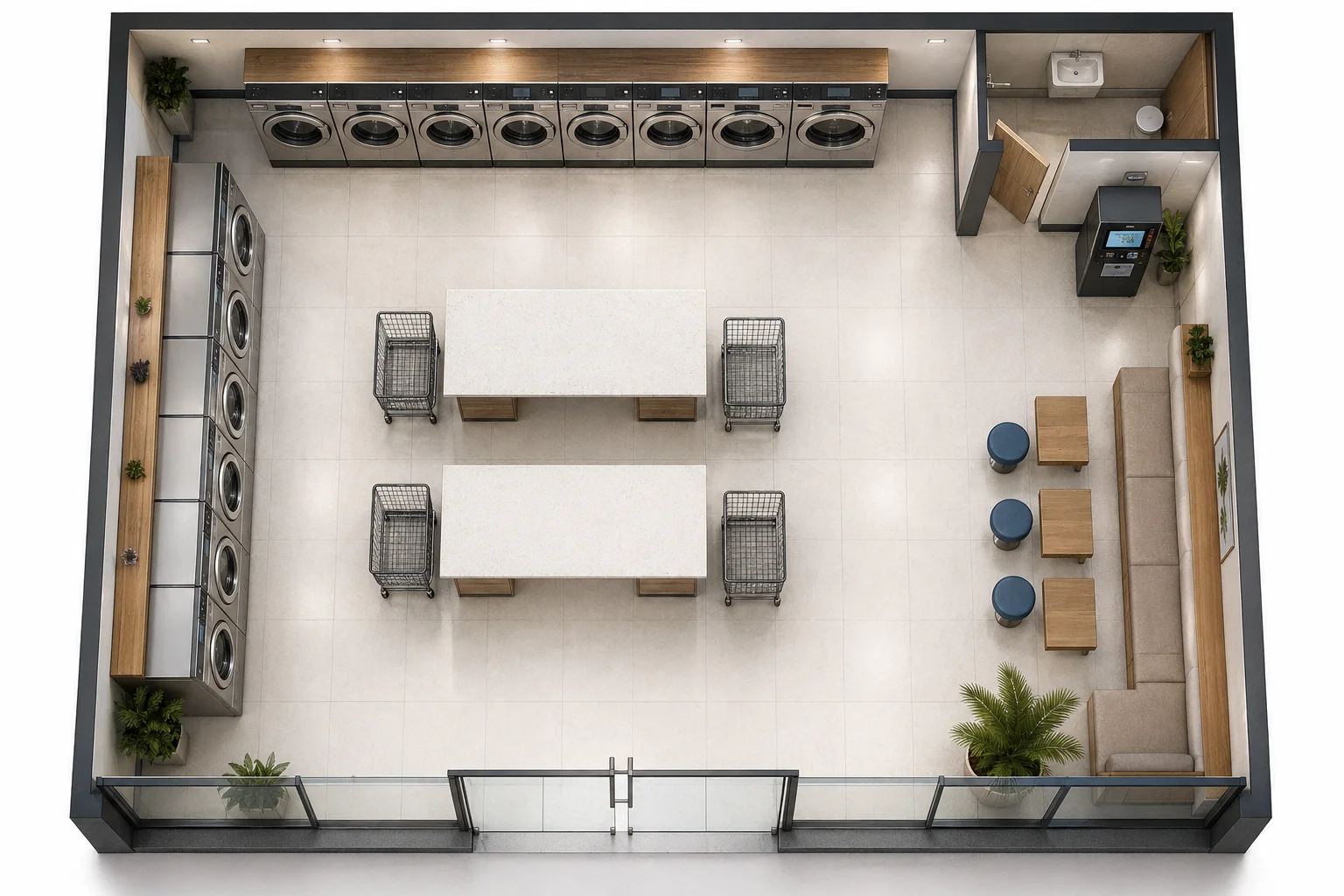
How Many Washing Machines Does a Laundromat Need in Malaysia?
This is one of the first questions every new dobi investor asks, and it is also one of the easiest to get wrong.
Some people buy too few machines. The shop fills up fast during peak hours, customers queue, leave bad reviews, and revenue stays low because throughput is capped.
Others over-invest from the start. Twelve machines in a 400 square foot shop lot, barely enough room to fold laundry, high electricity bills from day one, and machines sitting idle most of the day.
The right number sits between these two extremes, and it depends on a handful of variables specific to your shop lot, your location, and your target customers.
This guide walks through how to calculate the right machine count for a Malaysian laundromat from first principles, with real examples based on how actual dobi operators in Malaysia structure their setups.
The Variables That Actually Matter
Before you settle on a number, you need to understand what drives it. There are four main inputs.
1. Shop Lot Size
Your available floor space is the hard ceiling. You cannot fit more machines than your shop lot can physically hold, and you need to leave enough room for customers to move around comfortably.
A rough space guide for Malaysian laundromats:
- Each washer needs approximately 0.8 to 1.0 square metre of floor space, including side clearance
- Each dryer needs similar space, slightly more for stacked units including height clearance
- Aisles between machine rows need at least 1.5 metres of clear walking space for customers with laundry bags
- You also need space for folding tables, seating, token or payment machines, and a water filtration unit
Standard Malaysian shop lots typically come in these widths: 18 feet, 20 feet, and 24 feet. Depth varies more but is often 45 to 70 feet. Your usable laundry floor after accounting for a utility room or back area is usually smaller than the total lot size.
2. Target Customer Volume
How many customers do you expect per day? This depends heavily on location. A dobi in a dense residential area near university student accommodation will see completely different traffic from one in a quiet suburban neighbourhood.
A general industry benchmark: for every 100 regular customers per week, you need approximately 8 to 10 washers. This assumes each machine runs 2 cycles per hour during peak periods.
For a Malaysian neighbourhood dobi with modest traffic, planning for 50 to 80 regular customers per week is a reasonable starting estimate. A well-located outlet near high-density housing or student areas can realistically target 150 to 200 customers per week.
3. Washer-to-Dryer Ratio
This is the most commonly overlooked variable. Most first-time owners buy equal numbers of washers and dryers assuming a 1:1 ratio makes sense.
It usually does not.
Wash cycles typically run 30 to 45 minutes. Dry cycles typically run 40 to 60 minutes. During busy periods, customers finishing their wash find all dryers occupied. They wait. The bottleneck is always at the dryers.
A 1:1.3 or 1:1.5 ratio is more practical. For every 6 washers, plan for 8 to 9 dryers. This keeps the flow moving and reduces customer waiting time at the critical handover point between washing and drying.
We cover this in more detail in our guide on commercial tumble dryers in Malaysia.
4. Machine Capacity Mix
Not all customers bring the same size load. A Malaysian dobi typically serves:
- Single people and young couples doing personal laundry (8 to 10 kg loads)
- Families doing full weekly washes (14 to 20 kg loads)
- Customers with bulky items like comforters, carpets, and blankets (20 to 28 kg loads)
If you stock only one machine size, you leave money on the table. Customers with a small load will not want to pay for a 20 kg machine, and customers with a comforter cannot fit it in a 10 kg drum.
A mixed capacity setup captures more revenue per square metre and serves a wider range of customers.
Real Malaysian Laundromat Examples
Rather than giving you generic benchmarks, here is how established Malaysian operators actually structure their machine mix.
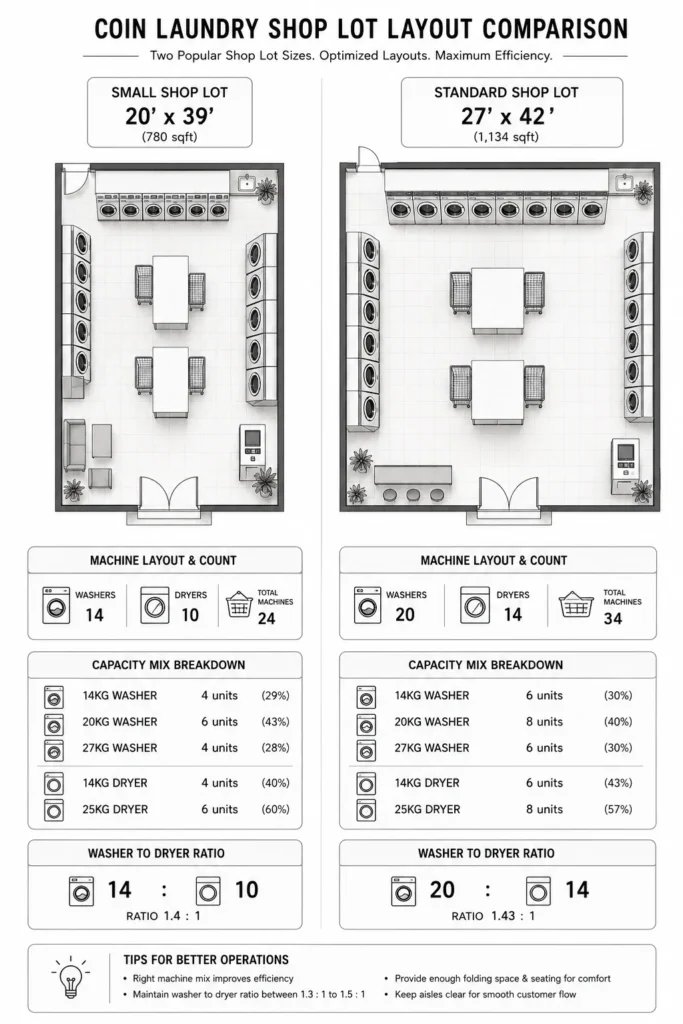
Small Outlet — 20 ft x 39 ft Shop Lot (Approximately 780 sqft)
Based on the myDobi 20×39 sqft package model, a typical small Malaysian dobi in this footprint runs:
Washers:
- 2 units of 14 kg
- 2 units of 20 kg
- 1 unit of 28 kg
- Total: 5 washers
Dryers:
- 3 stacked units of 14 kg + 14 kg
- 2 stacked units of 20 kg + 20 kg
- Total dryer capacity: 10 dryer pockets across 5 stacked units
This gives a washer-to-dryer ratio of roughly 1:2, accounting for stacked units. The setup covers everyday personal loads, family washes, and occasional bulky items without overwhelming the floor space.
Minimum starting point for any Malaysian dobi: 6 sets of washers and dryers. Below that, you will struggle to serve even modest traffic during peak hours without customers queueing.
Standard Outlet — 27 ft x 42 ft Shop Lot (Approximately 1,134 sqft)
A mid-sized Malaysian dobi in this footprint, again based on the myDobi 27×42 package structure:
Washers:
- 4 units of 14 kg
- 3 units of 20 kg
- 2 units of 28 kg
- Total: 9 washers
Dryers:
- 5 stacked units of 14 kg + 14 kg
- 2 stacked units of 20 kg + 20 kg
- 2 standalone units of 26 kg
- Total dryer capacity: 16 dryer pockets across 9 dryer units
This is a well-balanced setup for a moderate to high footfall location. The higher number of 14 kg stacked dryers captures fast turnover on smaller loads, while the 26 kg standalone dryers handle comforters and large family loads.
Average Malaysian laundromats with around 12 washers and dryers combined are commonly observed across the country, which aligns with this mid-sized setup.
Larger or Higher-Traffic Outlet
For a high-footfall location, such as near a university, in a dense urban township, or in an area with many single-occupant renters, you may need 12 to 16 washers and a proportionally higher number of dryers.
At this scale, the floor space requirement climbs significantly. You are typically looking at a 24-foot-wide or wider shop lot with at least 60 feet of depth to make the layout work without the shop feeling cramped.
A Simple Machine Count Framework
If you want a quick starting calculation before going into detailed planning:
| Shop Lot Size | Recommended Washers | Recommended Dryers |
|---|---|---|
| Under 700 sqft | 4 to 6 | 6 to 8 |
| 700 to 900 sqft | 6 to 8 | 8 to 12 |
| 900 to 1,200 sqft | 8 to 10 | 12 to 16 |
| 1,200 sqft and above | 10 to 16 | 14 to 20+ |
These are starting points. Your actual number should be adjusted based on your specific location, expected footfall, and machine capacity mix. A dobi near a university might push toward the upper end of each range. One in a quiet residential area might start lean and expand later.
Capacity Mix Guide by Customer Type
Use this to decide how to split your washers across different sizes:
| Customer Type | Recommended Machine Size |
|---|---|
| Students, singles, couples | 10 to 14 kg |
| Small families, weekly washes | 14 to 20 kg |
| Large families, full loads | 20 to 28 kg |
| Comforters, carpets, bulk items | 22 to 28 kg+ |
A typical split for a balanced Malaysian dobi: roughly 40% small capacity (10 to 14 kg), 40% medium (18 to 20 kg), and 20% large (24 to 28 kg).
In areas with a lot of student tenants, shift the split toward more small and medium machines. In family-heavy residential areas, skew toward medium and large.
The Phased Approach — Start Lean, Expand When Ready
One mistake many Malaysian dobi investors make is trying to fill every available square metre from day one.
A smarter approach is to start with 60 to 70% of your planned machine capacity, then add machines as your customer base grows and your revenue data tells you where the demand is.
This keeps your startup capital lower, reduces your electricity bill during the early months when foot traffic is still building, and gives you real data to guide expansion decisions rather than guessing.
When planning your shop layout, design it to accommodate the expanded machine count from the start. Pre-run the electrical conduit and water piping to future machine positions. Adding machines later becomes a simple plug-in rather than a renovation project.
Our self-service laundromat setup service includes layout planning that accounts for phased expansion, so you do not paint yourself into a corner during the initial fit-out.
Electricity Cost Planning by Machine Count
Your electricity bill is directly linked to how many machines you run and how many hours per day they operate.
For a Malaysian commercial laundromat under TNB’s commercial tariff:
- A 14 kg commercial washer uses approximately 1.5 to 2.5 kWh per cycle
- A 14 kg electric dryer uses approximately 3 to 4 kWh per cycle
- At TNB commercial rates, each washer cycle costs roughly RM 0.80 to RM 1.50 in electricity
- Each dryer cycle costs roughly RM 1.50 to RM 2.50 in electricity
For 10 machines running an average of 10 cycles per day each, your electricity cost alone can reach RM 5,000 to RM 10,000 per month depending on your capacity mix and whether your dryers are gas or electric.
Gas dryers significantly reduce the drying cost component. If your shop lot allows for gas installation, it is worth factoring into your planning from the start.
For a detailed cost model specific to your planned machine count and location, our finance advisory service builds out a full monthly P&L projection before you commit to equipment.
Coin-Op vs Cashless — Does It Change the Machine Count?
Not the count itself, but it changes how you think about throughput.
Cashless systems (e-wallet, QR, NFC) tend to speed up the payment step and reduce abandoned cycles from customers who run out of coins. Faster payment means higher machine utilisation during peak hours, which means your existing machine count effectively generates more revenue.
If you are planning a cashless or hybrid setup, you may be able to achieve your revenue targets with a slightly lower machine count than a coin-only equivalent, though the quality of your location and hours of operation matter much more than payment method.
Our business consultancy service covers payment system selection as part of the broader business setup process.
Frequently Asked Questions
What is the minimum number of machines for a Malaysian dobi?
The minimum viable setup for a self-service laundromat in Malaysia is 6 sets of washers and dryers. Below this, you cannot serve even modest customer traffic effectively during peak hours.
Should I have more dryers than washers in my laundromat?
Yes, in most cases. Because dry cycles take longer than wash cycles, you need more drying capacity to prevent a bottleneck. A ratio of 1 washer to 1.3 to 1.5 dryers is a practical starting point for Malaysian dobi operators.
How many machines fit in a standard Malaysian shop lot?
A standard 20 ft x 39 ft shop lot (approximately 780 sqft) typically fits 5 to 6 washers and 5 to 6 dryer units (including stacked configurations). A 27 ft x 42 ft lot can accommodate 9 washers and up to 9 dryer units comfortably.
Is it better to start with more machines or fewer?
Starting with 60 to 70% of your planned capacity and expanding as demand grows is often the smarter approach. It reduces startup costs and electricity bills during the early trading period while giving you real data to guide expansion.
How much does electricity cost for a Malaysian laundromat?
It varies significantly by machine count, capacity, daily operating hours, and whether you use gas or electric dryers. A 10-machine electric dobi running 10 cycles per machine per day can generate electricity costs of RM 5,000 to RM 10,000 per month. Gas dryers reduce the drying cost component substantially.
What machine sizes should I stock in my dobi?
A balanced mix across small (10 to 14 kg), medium (18 to 20 kg), and large (24 to 28 kg) machines captures the widest range of customers. Adjust the split based on whether your location skews toward students, families, or a mixed demographic.
Plan Your Laundromat the Right Way
Getting the machine count right is one part of a larger planning process. Location, layout, machine brand, payment system, utility costs, and marketing all affect whether your dobi succeeds.
Launch Laundry supports first-time and experienced laundromat investors across Malaysia with end-to-end guidance. Our services cover:
- Strategy and business planning — before you sign the tenancy
- Finance advisory — equipment budgeting, cash flow, and leasing options
- Full laundromat setup — layout, machines, installation, and fit-out
- Revenue growth — once you are open and trading
View our products page to see the commercial washers and dryers we supply, or get in touch with our team to talk through your plans.
We cover Kuala Lumpur, Selangor, Penang, Johor Bahru, Melaka, and Sabah and Sarawak. Find your nearest support through our locations page.