


How Long Does It Take for a Laundromat to Break Even in Malaysia
Every laundromat investor in Malaysia eventually asks the same question: when will I get my money back?
It is a fair question. You are putting in anywhere from RM150,000 to RM500,000 or more before you earn a single Ringgit. Rent is running before the machines are even installed. Understanding the realistic timeline to break even is not just useful for peace of mind. It is essential for planning your cash flow, deciding how much working capital to hold, and making sure you have not committed to a location or setup that the numbers simply cannot support.
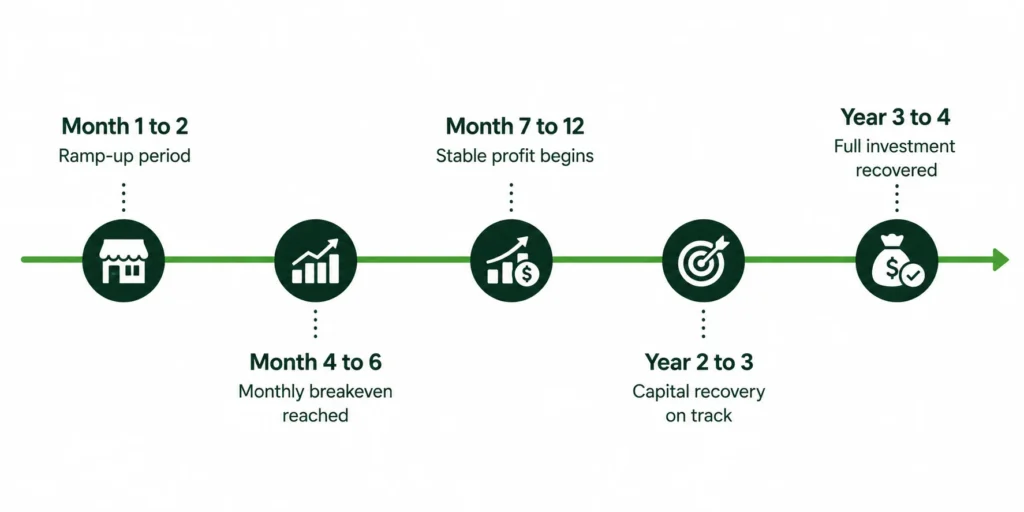
The honest answer is that a well-located, well-run Malaysian laundromat typically breaks even on its monthly operating costs within four to seven months of opening, and recovers its full capital investment within two and a half to four years. But those timelines vary significantly depending on your setup size, your location, your rent, and how quickly you build a loyal customer base.
This guide walks you through exactly how breakeven is calculated for a Malaysian laundromat, what the numbers look like across three realistic scenarios, and the specific factors that can make your timeline faster or slower.
Two Types of Breakeven You Need to Understand
Most people use the word breakeven to mean one thing, but in a laundromat business there are actually two separate milestones worth tracking.
The first is monthly operational breakeven. This is the point where your monthly revenue covers all your monthly operating expenses including rent, utilities, maintenance, insurance, and any loan repayment. Once you hit this point, you stop losing money each month. This typically happens within the first year for a well-located laundromat.
The second is full capital recovery. This is when your cumulative net profit equals your total startup investment. At this point, every Ringgit you earn going forward is a return above and beyond what you originally put in. This takes longer, usually two and a half to four years for a Malaysian laundromat.
Both milestones matter. Monthly breakeven tells you whether the business is operationally viable. Capital recovery tells you what your true return on investment looks like over time.
How to Calculate Your Monthly Breakeven Point
Your monthly breakeven point is simply the level of revenue you need to cover all your fixed and variable monthly costs.
The formula is straightforward:
Monthly breakeven revenue = total fixed monthly costs + variable costs at that revenue level
For most Malaysian laundromats, the main monthly costs are:
| Expense | Typical Range (RM) |
|---|---|
| Shop rent | 1,500 to 5,000 |
| Electricity | 1,200 to 2,500 |
| Water | 400 to 800 |
| Gas (if using gas dryers) | 300 to 600 |
| Machine maintenance | 300 to 600 |
| Loan repayment (if applicable) | 2,000 to 5,000 |
| Insurance | 100 to 200 |
| License renewals (monthly allocation) | 50 to 100 |
| Cleaning and consumables | 150 to 300 |
| Marketing | 200 to 500 |
| Miscellaneous | 150 to 300 |
Once you know your total monthly costs, divide that number by your average revenue per cycle and the number of cycles needed becomes clear.
For example, if your total monthly costs are RM7,500 and you charge an average of RM4.50 per cycle across washers and dryers, you need RM7,500 divided by RM4.50 = 1,667 cycles per month to break even.
If you have 14 machines operating 17 hours a day for 30 days, your theoretical maximum capacity is roughly 14 machines multiplied by 8 cycles per day multiplied by 30 days = 3,360 cycles per month at full capacity. Breaking even at 1,667 cycles means you need to run at roughly 50 percent utilisation, which is an achievable target for a well-located laundromat by month three to five.
Three Real Malaysian Laundromat Scenarios
Rather than giving you one set of numbers, here are three scenarios based on common setups we see across Malaysia. Each one shows the monthly breakeven point, how long it takes to reach it, and the capital recovery timeline.
Scenario A: Mini Laundromat in a Residential Area, RM180,000 Investment
This is a small setup in a residential neighbourhood in Selangor or Penang. 8 machines total, 400 square foot unit, rent at RM1,800 per month, no bank loan, owner-operated.
Monthly cost structure:
| Expense | Monthly Cost (RM) |
|---|---|
| Rent | 1,800 |
| Electricity | 900 |
| Water | 350 |
| Gas | 250 |
| Maintenance | 250 |
| Insurance and licenses | 120 |
| Marketing | 200 |
| Miscellaneous | 130 |
| Total monthly costs | RM4,000 |
Revenue build-up:
| Period | Utilisation | Daily Revenue | Monthly Revenue |
|---|---|---|---|
| Month 1 to 2 | 35% | RM100 | RM3,000 |
| Month 3 to 4 | 50% | RM143 | RM4,290 |
| Month 5 to 6 | 65% | RM186 | RM5,580 |
| Month 7 onwards | 75% | RM214 | RM6,420 |
Pricing: RM5 wash, RM4 dry. 8 machines average 8 possible cycles per day at full capacity.
Monthly operational breakeven reached: Month 3 to 4 (when revenue crosses RM4,000)
Annual net profit once established (from month 7): Monthly net = RM6,420 minus RM4,000 = RM2,420. Annual net = approximately RM29,000.
Capital recovery timeline: RM180,000 divided by RM29,000 per year = approximately 6.2 years at this pace. However, utilisation typically continues to improve as the business matures. At 85 percent utilisation the annual net rises to around RM40,000, bringing capital recovery down to approximately 4.5 years.
Scenario B: Small Laundromat Near a University, RM280,000 Investment
This is the most common investor profile we see. 14 machines, 500 square foot unit near a college or apartment cluster in KL or Selangor, rent at RM2,500 per month, partial bank loan of RM150,000 over five years.
Monthly cost structure:
| Expense | Monthly Cost (RM) |
|---|---|
| Rent | 2,500 |
| Electricity | 1,500 |
| Water | 550 |
| Gas | 400 |
| Maintenance | 400 |
| Loan repayment | 2,900 |
| Insurance and licenses | 150 |
| Marketing | 300 |
| Miscellaneous | 200 |
| Total monthly costs | RM8,900 |
Revenue build-up:
| Period | Utilisation | Daily Revenue | Monthly Revenue |
|---|---|---|---|
| Month 1 to 2 | 35% | RM163 | RM4,890 |
| Month 3 to 5 | 52% | RM242 | RM7,260 |
| Month 6 to 9 | 65% | RM303 | RM9,090 |
| Month 10 onwards | 75% | RM350 | RM10,500 |
Pricing: RM5 wash, RM4 dry. 14 machines average 8 possible cycles per day at full capacity.
Monthly operational breakeven reached: Month 6 to 7 (when revenue crosses RM8,900)
Net profit once established (from month 10): Monthly net = RM10,500 minus RM8,900 = RM1,600. Annual net in year 1 = approximately RM10,000 (weighted for ramp-up period). Annual net in year 2 at 80 percent utilisation = approximately RM28,000. Annual net in year 3 at 85 percent utilisation = approximately RM35,000.
Capital recovery timeline: Own contribution was RM130,000. Cumulative profit of RM130,000 reached approximately 3.5 to 4 years after opening. Full debt repayment completes in year five, after which net profit rises to approximately RM5,900 per month as the loan payment drops out.
Scenario C: Full-Sized Laundromat in a High-Density Area, RM450,000 Investment
This is a more ambitious setup. 22 machines, 900 square foot unit in a high-density area of KL or Petaling Jaya, rent at RM4,500 per month, bank loan of RM250,000 over five years.
Monthly cost structure:
| Expense | Monthly Cost (RM) |
|---|---|
| Rent | 4,500 |
| Electricity | 2,200 |
| Water | 800 |
| Gas | 600 |
| Maintenance | 600 |
| Loan repayment | 4,833 |
| Insurance and licenses | 200 |
| Marketing | 400 |
| Miscellaneous | 300 |
| Total monthly costs | RM14,433 |
Revenue build-up:
| Period | Utilisation | Daily Revenue | Monthly Revenue |
|---|---|---|---|
| Month 1 to 2 | 35% | RM255 | RM7,650 |
| Month 3 to 5 | 50% | RM365 | RM10,950 |
| Month 6 to 9 | 62% | RM452 | RM13,560 |
| Month 10 to 12 | 72% | RM525 | RM15,750 |
| Year 2 average | 80% | RM584 | RM17,520 |
Pricing: RM5.50 wash average, RM4.50 dry average. 22 machines average 8 possible cycles per day at full capacity.
Monthly operational breakeven reached: Month 9 to 11 (when revenue crosses RM14,433)
Net profit once established: Month 12 monthly net = RM15,750 minus RM14,433 = RM1,317. Year 2 monthly net = RM17,520 minus RM14,433 = RM3,087. Year 3 monthly net at 85 percent utilisation = approximately RM4,500.
Capital recovery timeline: Own contribution was RM200,000. At RM3,087 per month net in year two and RM4,500 per month in year three, cumulative profit reaches RM200,000 approximately 4 to 4.5 years after opening. Once the loan clears in year five, monthly net jumps to over RM9,000 as the RM4,833 repayment drops out.
Utilisation Rate: The Number That Drives Everything
If there is one number that determines how quickly your laundromat breaks even, it is your machine utilisation rate. This is the percentage of total possible cycles your machines are actually running each day.
A machine that could theoretically run 8 cycles per day but only runs 4 cycles per day is operating at 50 percent utilisation.
Most new Malaysian laundromats open at 30 to 40 percent utilisation. Customers do not know you exist yet, habits have not formed, and word of mouth has not built up. This is normal and expected. It is why a working capital buffer covering three to five months of operating costs is not optional.
Well-located laundromats with consistent marketing and clean, reliable machines typically reach 60 to 70 percent utilisation by month four to six. Mature laundromats in strong locations operate at 75 to 85 percent, and some well-established outlets in high-density urban areas run above 85 percent during peak months.
Here is what utilisation means for a 14-machine laundromat charging RM5 per wash and RM4 per dry, operating 17 hours a day:
| Utilisation Rate | Daily Revenue | Monthly Revenue |
|---|---|---|
| 30% | RM139 | RM4,170 |
| 40% | RM186 | RM5,580 |
| 50% | RM233 | RM6,990 |
| 60% | RM280 | RM8,400 |
| 70% | RM326 | RM9,780 |
| 80% | RM373 | RM11,190 |
| 85% | RM396 | RM11,880 |
The gap between 40 percent and 70 percent utilisation is the difference between a business that is losing money every month and one that is generating a comfortable profit. This is why location, marketing, machine reliability, and shop cleanliness matter so much in the first year.
What Speeds Up Your Breakeven
Choosing the right location. A laundromat in a high-density renter area with limited competition will ramp up faster than one in a mixed residential area with several competitors. The single biggest decision you make is where you open.
Opening with all machines functional. Customers who visit in your first two weeks and find machines out of order leave and do not come back easily. Opening day must have every machine tested and running perfectly. First impressions in a laundromat are built on reliability.
Starting marketing before you open. Google Maps listing, a WhatsApp broadcast to nearby residents, flyers in the apartment blocks within 500 metres, a simple opening promotion. These cost very little but can meaningfully accelerate your ramp-up from 30 to 50 percent utilisation in the first month instead of the second.
Setting competitive prices from day one. Check what nearby laundromats charge before you set your prices. Pricing even 50 sen below the nearest competitor can bring customers to you in the first month who would otherwise go somewhere familiar.
Keeping the shop clean without exception. A Malaysian laundromat customer who walks into a clean, well-lit, properly ventilated shop feels confident using it. One who finds lint on the floor and damp smells walks out. Cleanliness is not maintenance. It is marketing.
Cashless payment from day one. A significant proportion of younger Malaysian customers do not carry coins. Offering DuitNow QR or TNG eWallet payment from the day you open removes a barrier that coin-only laundromats still put in front of customers.
What Slows Down Your Breakeven
High rent relative to footfall. Signing a lease at RM4,500 per month in an area that can only support RM10,000 in monthly revenue means your margins are permanently thin. Always run the rent-to-revenue ratio before committing to a location.
Machines that break down frequently. Every machine that is out of service is revenue you cannot earn. A washer that sits broken for two weeks loses you hundreds of Ringgit in cycles. Cheap machines that were not built for commercial volume are the most common reason Malaysian laundromats take longer to break even than projected.
Underestimating your working capital need. Running out of cash in month two because you spent everything on setup forces you to make short-term decisions that hurt the business. A realistic working capital buffer of at least RM15,000 to RM30,000 depending on your setup size is essential.
No marketing in the first three months. A laundromat is not a walk-in destination on day one. People need to know it is there. Relying entirely on passing footfall without any active outreach to nearby residents or businesses extends your ramp-up period significantly.
Choosing the wrong machine mix. A laundromat with only 10 kg machines will frustrate customers who need to wash comforters, curtains, or large loads. They will go somewhere else. Getting the machine size mix right for your specific customer base affects both your revenue per cycle and your customer retention.
What ROI Actually Looks Like over Five Years
To make this concrete, here is what the full five-year picture looks like for Scenario B, the most common investor profile: 14 machines, RM280,000 investment, RM150,000 bank loan over five years.
| Year | Annual Revenue | Annual Costs | Annual Net Profit | Cumulative Net |
|---|---|---|---|---|
| Year 1 | RM89,000 | RM106,800 | (RM17,800) | (RM17,800) |
| Year 2 | RM117,600 | RM106,800 | RM10,800 | (RM7,000) |
| Year 3 | RM127,200 | RM106,800 | RM20,400 | RM13,400 |
| Year 4 | RM132,000 | RM106,800 | RM25,200 | RM38,600 |
| Year 5 | RM136,800 | RM106,800 | RM30,000 | RM68,600 |
Note: Year 1 shows a net loss because of the ramp-up period where revenue is below breakeven for the first six months. This is normal and expected, and is why the working capital buffer exists.
After the loan is fully repaid in year five, the annual net profit rises to approximately RM65,000 to RM70,000 per year as the monthly loan repayment of RM2,900 drops out of the cost structure. At that point, a RM280,000 investment is generating over 23 percent annual return on the original capital, which compares favourably to most passive investment alternatives in Malaysia.
Full capital recovery of the RM130,000 own contribution is reached during year three. Full recovery including the total loan repaid to the bank over five years is complete by around year six to seven, at which point the business generates strong net profit with no debt servicing.
Is a Malaysian Laundromat Worth the Wait?
The numbers above show that a Malaysian laundromat is not a get-rich-quick investment. The ramp-up period requires patience and working capital. The first year is often cash-flow negative even for well-located outlets.
But the long-term picture is consistently strong for laundromats that are properly set up. The business is recession-resistant because laundry is not discretionary. The demand is recurring because customers come back every week. The operating model is largely passive once the machines are running reliably and the customer base is established.
The investors who struggle are almost always those who got the location wrong, ran out of working capital in the first three months, or bought poor-quality machines that broke down before the business had a chance to build momentum. The investors who succeed are those who planned the numbers honestly, held enough cash to survive the ramp-up, and kept the shop clean and the machines running from day one.
If you want to model the breakeven timeline for your specific setup before you commit to a location or a machine configuration, our Finance Advisory for Laundry Startups service builds a custom financial model based on your actual rent, machine count, pricing, and location demographics.
You can also speak directly with our team through our Business Consultancy for Laundromat Investors service, where we work through the full investment decision with you from location selection to opening day.
Talk to us on WhatsApp and we will help you build a realistic picture before you sign anything.
Frequently Asked Questions
How long does it typically take a Malaysian laundromat to break even?
Monthly operational breakeven, meaning the point where revenue covers all running costs, typically occurs between month four and month seven for a well-located Malaysian laundromat. Full capital recovery of the total startup investment usually takes two and a half to four years, depending on the size of the investment, the rent, the utilisation rate, and whether a bank loan is involved.
What utilisation rate do I need to break even?
This depends on your specific cost structure, but for most small Malaysian laundromats, monthly breakeven requires a utilisation rate of between 45 and 60 percent. New laundromats typically open at 30 to 40 percent utilisation and build toward this level over the first three to six months. A laundromat that is still below 50 percent utilisation after six months needs to examine its location, marketing, or machine reliability as a priority.
Does a bank loan make my breakeven timeline longer?
Yes. Loan repayments are a fixed monthly cost that increases your breakeven revenue threshold. However, a loan also reduces the amount of personal cash you need to invest upfront, which changes the risk profile of the investment. The right answer depends on how much working capital you retain after setup. Investors who take a loan but maintain a healthy cash buffer often perform better in the first year than those who invest all their own cash and have nothing left for the ramp-up period.
What is a realistic annual ROI for a Malaysian laundromat?
Once the business is past the ramp-up phase and operating at 70 to 80 percent utilisation, annual return on investment for a well-run Malaysian laundromat is typically between 20 and 35 percent on the original capital invested. After loan repayment is complete, the return increases further. Some sources cite Malaysian laundromat ROI as high as 40 to 50 percent for well-managed businesses in high-demand locations, though this represents the upper end of what is achievable rather than the typical case.
What happens if my laundromat does not reach breakeven in the expected timeframe?
If you are past month six and still significantly below breakeven, the most common causes are insufficient footfall from the location, machines that are frequently out of service, pricing that is misaligned with local competitors, or a lack of visibility in the community. The first thing to check is whether nearby laundromats are busy while yours is not. If they are, the problem is marketing or awareness. If they are equally slow, the issue may be the location itself. Our Research Planning for Laundry Businesses service can help you diagnose the issue and identify corrective actions.
Can I speed up my breakeven by raising prices?
Raising prices increases revenue per cycle but risks reducing your utilisation rate if your prices move above what the local market supports. The safer approach in the first year is to price competitively at or slightly below the nearest well-run competitor, build your customer base and utilisation rate, and then consider small price increases once you have established loyalty. A 50 sen increase on a wash cycle adds RM3,000 to RM4,000 in annual revenue on a 14-machine laundromat at 70 percent utilisation, which is meaningful without being the kind of jump that drives customers away.