


Coin vs Cashless Laundromat Which Payment System Is Right for Malaysia
When you are planning a laundromat in Malaysia, one of the first equipment decisions you will face is also one of the most debated among investors: should you go with coin-operated machines, a fully cashless payment system, or a hybrid of both?
It sounds like a simple choice. In practice, it affects your startup cost, your daily operations, your exposure to theft, your customer experience, and ultimately your monthly profit margin. Getting it wrong does not sink the business, but it does create friction that could have been avoided.
This guide gives you an honest, side-by-side look at both options based on what actually works in the Malaysian market today. We will cover the setup costs, the real-world pros and cons of each, how TNG eWallet and DuitNow fit into the picture, and a clear recommendation based on the type of location you are targeting.
Where Malaysia Stands on Cashless Payments Right Now
Before comparing the systems, it helps to understand the payment landscape your customers are operating in.
Malaysia has one of the highest eWallet adoption rates in Southeast Asia. According to Bank Negara Malaysia’s 2024 Annual Report, ePayment transactions per capita reached 409 in 2024, up from 343 the year before. eWallets and eMoney now account for 38 percent of all electronic payment transactions in Malaysia, almost on par with online banking. DuitNow QR transactions more than doubled from 360 million in 2023 to 870 million in 2024.
Touch ‘n Go eWallet, the largest player in Malaysia with over 20 million verified users and 13 million monthly active users as of 2024, has become the default payment method for millions of Malaysians across all age groups, not just younger users.
What this means for laundromat operators is that a large and growing proportion of your potential customers already carry no coins and very little physical cash. They pay for their teh tarik, their parking, their groceries, and their toll charges using their phone. Expecting them to carry the exact coin denomination for your machines is a friction point that did not exist ten years ago but is very real today.
This does not mean coin systems are dead in Malaysia. They are still widely used and still work. But the trend is clear, and anyone opening a new laundromat now needs to factor it into their decision.
How Coin Payment Systems Work
A coin-operated laundromat is exactly what it sounds like. Customers insert coins directly into each machine to start a cycle. There is no central payment point and no digital transaction involved.
Most coin laundromats in Malaysia currently use RM1 coins, though some older machines still run on 50 sen pieces. The price per cycle is set by the machine programming, and customers need to have the exact denomination ready.
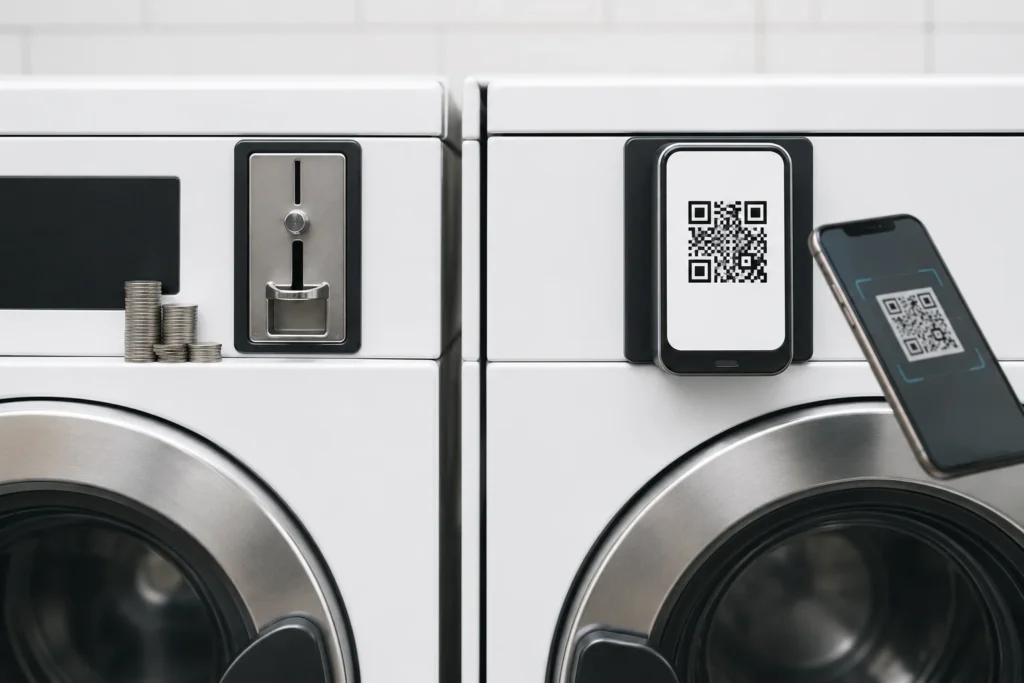
Some coin laundromats add a coin change machine, which is a standalone unit that accepts RM5, RM10, or RM50 notes and dispenses coins. This solves the problem of customers needing to arrive with coins already in hand, though it adds another piece of equipment to maintain.
Setup cost for coin payment:
| Item | Cost (RM) |
|---|---|
| Coin mechanism (built into machine) | Included in machine price or RM500 to RM1,000 to add |
| Coin change machine (one per outlet) | RM3,000 to RM8,000 |
| Installation and testing | RM200 to RM500 |
For a 14-machine outlet, the coin payment infrastructure adds roughly RM10,000 to RM15,000 to your total setup cost when you include a change machine.
How Cashless Payment Systems Work in Malaysia
Cashless laundromat payment in Malaysia primarily works through two methods: DuitNow QR code terminals and integrated payment kiosks.
DuitNow QR terminals are the most common cashless solution being installed in Malaysian laundromats right now. A terminal is attached to each machine or placed nearby. The customer opens their banking app or eWallet, scans the QR code, enters the amount, and confirms payment. The machine then starts. This works with TNG eWallet, Boost, GrabPay, MAE, and all major Malaysian banking apps that support DuitNow QR.
Local providers such as Transpire QR have developed terminals specifically designed for self-service laundromats, with real-time sales tracking, machine error notifications, and a cloud dashboard that lets the operator monitor revenue and usage remotely without visiting the shop.
Integrated payment kiosks are a central unit placed in the shop where customers top up a stored-value card or pay for a specific machine. Some kiosks accept both cash and cashless, which gives customers flexibility. These are more common in larger laundromats where the owner wants a single payment point rather than individual terminals on each machine.
Setup cost for cashless payment:
| Item | Cost (RM) |
|---|---|
| DuitNow QR terminal per machine | RM800 to RM1,500 per unit |
| Central payment kiosk (for 14-machine outlet) | RM6,000 to RM12,000 |
| Installation and configuration | RM500 to RM1,500 |
| Monthly transaction fee or SaaS subscription | RM50 to RM200 per month |
For a 14-machine outlet going fully cashless with individual terminals, the setup cost is approximately RM12,000 to RM21,000. A central kiosk approach for the same outlet costs RM7,000 to RM14,000 but gives customers less individual machine flexibility.
Most cashless providers also charge a merchant discount rate on each transaction, similar to a credit card processing fee. In Malaysia this typically ranges from 0.5 to 1.5 percent per transaction for DuitNow QR, which is relatively low compared to card payment systems in other countries.
Side by Side Comparison
| Factor | Coin System | Cashless System |
|---|---|---|
| Setup cost | Lower (RM10,000 to RM15,000) | Higher (RM12,000 to RM21,000) |
| Ongoing transaction cost | None | 0.5% to 1.5% per transaction |
| Customer convenience | Lower (need exact coins) | Higher (phone payment) |
| Theft and security risk | Higher (cash in machines) | Lower (little to no cash on site) |
| Machine downtime from jams | Higher (coin slots jam) | Lower (no mechanical coin handling) |
| Revenue tracking | Manual (count coins) | Automatic (cloud dashboard) |
| Remote monitoring | Not possible | Yes, from phone or laptop |
| Works for older demographics | Yes | Partially (some older users prefer cash) |
| Works for younger demographics | Partially | Yes |
| Pricing flexibility | Low (fixed by machine) | High (adjust remotely) |
| Loyalty programmes | Not possible | Possible with some systems |
| Internet dependency | None | Requires stable internet |
The Real Problems with Coin Systems in Malaysia Today
Coin systems are reliable and time-tested, but operators who have been running coin laundromats for several years will tell you about the problems that accumulate over time.
Coin jams. The most common day-to-day issue. Bent coins, foreign coins, and worn coin slots cause jams that stop machines mid-cycle and frustrate customers. The operator gets a call, has to drive to the shop, open the machine, clear the jam, and restart. This happens more often than most investors expect.
Coin theft. A laundromat full of machines containing coins is an attractive target. Coin box break-ins happen across Malaysia. The damage to the machine and the cost of repairs often exceeds the value of the coins stolen. In areas with higher crime rates, this can become a recurring problem that is costly and stressful to deal with.
Coin collection logistics. Someone has to visit the shop regularly to collect the coins from every machine, count them, bag them, and deposit them at a bank. This takes time every week, and if the shop is unattended, it means the owner doing it personally. As you add more machines or more outlets, this becomes increasingly time-consuming.
No revenue visibility. With coins, you cannot see in real time how much revenue your shop is generating without physically being there and counting the coins. You cannot tell which machines are running more cycles, what times are busiest, or whether there is a discrepancy between what you expected and what you collected.
Declining coin availability. Bank Negara Malaysia reduced coin circulation in recent years, and getting enough RM1 coins from banks has become harder. Some laundromat operators report customers leaving because they could not get change.
The Real Limitations of Cashless Systems in Malaysia
Cashless is not perfect either. Here is what operators find challenging.
Internet dependency. If your shop’s internet connection goes down, cashless terminals cannot process payments. For a 24-hour laundromat this can mean hours of revenue loss if the issue is not resolved quickly. A backup internet plan, whether a mobile data SIM or a secondary broadband connection, is worth building into your operating costs.
Older customer demographics. In areas where the customer base includes a significant proportion of older residents, migrant workers, or people who are less comfortable with eWallets, a fully cashless system can exclude customers who would otherwise use your service. This is a real consideration in certain locations, particularly smaller towns and working-class areas where smartphone adoption and eWallet usage may be lower than in urban KL or Subang.
Technical glitches. Cashless terminals have software, connectivity, and hardware components that can fail. When they do, customers who want to use the machine cannot pay. Having a basic troubleshooting process and a direct line to your payment system provider matters more than it does with a coin machine that either works or does not.
Setup and subscription cost. The upfront cost is higher than coin, and some cashless providers also charge a monthly subscription or management fee. Over a five-year operating period the total cost of cashless infrastructure is higher than coin infrastructure, though this can be offset by the reduction in maintenance time, coin collection costs, and theft losses.
The Hybrid Model: Coin Plus Cashless
Many Malaysian laundromats that have been operating for several years are now retrofitting cashless terminals onto machines that were originally coin-only. This hybrid approach allows you to serve both types of customers and is a practical middle ground if you are uncertain about your customer demographics.
In practice, most hybrid laundromats find that cashless usage gradually becomes dominant as customers get comfortable with the payment method. Within 12 to 18 months of adding cashless, many operators report that 60 to 80 percent of transactions are cashless even when the coin option remains available.
The hybrid model costs more to set up than either system alone, but it de-risks your entry by not betting entirely on one payment behaviour.
Estimated hybrid setup cost for a 14-machine outlet:
| Item | Cost (RM) |
|---|---|
| Coin mechanisms (existing or added) | RM7,000 to RM10,000 |
| DuitNow QR terminals (one per machine) | RM11,200 to RM21,000 |
| Coin change machine | RM3,500 to RM6,000 |
| Total | RM21,700 to RM37,000 |
Our Recommendation Based on Location Type
There is no single right answer for every Malaysian laundromat. The best payment system depends on where you are and who your customers are.
Urban residential areas in KL, PJ, Subang, Cyberjaya, Cheras, Kepong. Go cashless or hybrid from day one. Your customer base is predominantly young working adults and students who pay for everything digitally. A coin-only setup in these areas in 2025 and beyond will feel outdated and create unnecessary friction. Full cashless or hybrid is the right call.
Near universities and college campuses. Cashless is strongly preferred. Students are among the highest eWallet users in Malaysia. Many do not carry coins at all. A DuitNow QR system fits this demographic perfectly and also allows you to run student promotions through the payment platform.
Industrial and worker accommodation areas. Hybrid is the safer choice here. Factory workers and migrant workers tend to use cash more than the urban average. A cashless-only system may exclude a meaningful portion of your customer base. Adding coin or cash payment alongside cashless ensures you do not lose revenue from customers who cannot or do not want to pay digitally.
Smaller towns and secondary cities. Hybrid or coin with a change machine. eWallet adoption is growing across Malaysia but is still lower in smaller towns compared to the Klang Valley. A fully cashless system may feel unfamiliar to a portion of your customer base. Offering both gives you coverage across all segments.
Existing coin laundromats looking to upgrade. Retrofit DuitNow QR terminals onto your machines without removing the coin option. This is the lowest-risk upgrade path and lets you observe which payment method your specific customers prefer before making any further changes.
What About the ROI Difference Between Coin and Cashless?
In terms of pure revenue per machine, the payment system does not significantly change how much each cycle earns. Your revenue is driven by utilisation rate and pricing, not by payment method.
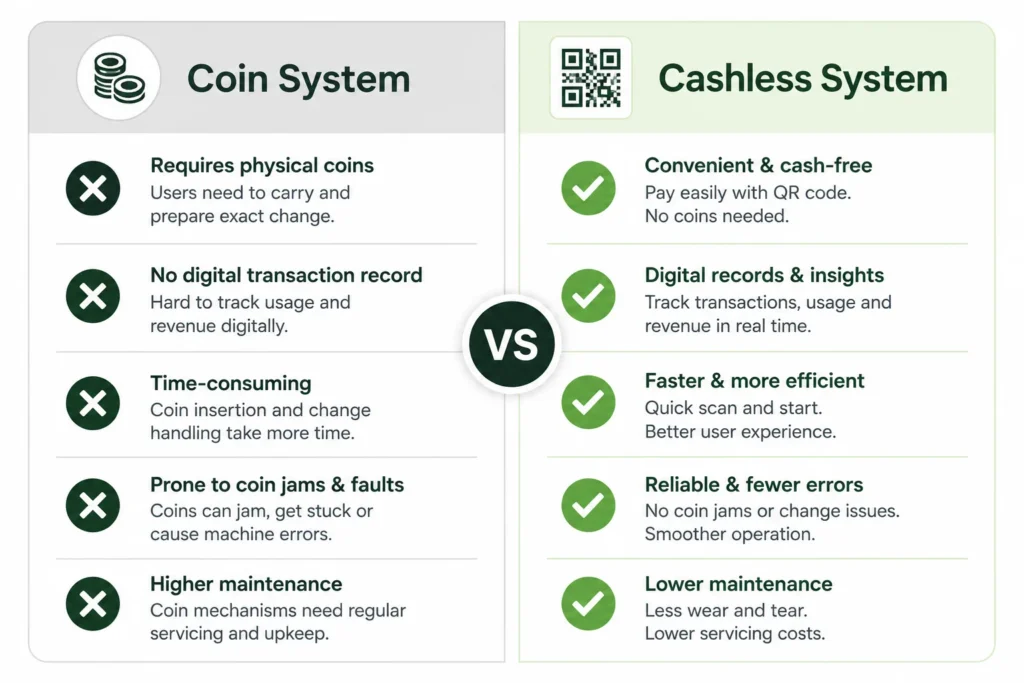
Where cashless creates a measurable financial advantage is on the cost side:
- Reduced coin collection time saves several hours per week that the owner or staff would otherwise spend at the shop
- Reduced machine downtime from coin jams means more cycles completed and more revenue earned per machine per day
- Reduced theft losses remove a recurring unpredictable cost that coin operators have to absorb
- Real-time revenue visibility lets you identify underperforming machines faster and act on them
These savings are real but hard to quantify precisely until you are operating. Most operators who switch from coin to cashless or hybrid report that the operational relief is worth the upfront investment within the first year.
If you want to talk through which payment system makes most sense for your specific location and customer demographic before you commit to a setup, our Research Planning for Laundry Businesses service can help you make this decision with better data.
Talk to our team on WhatsApp and we can walk you through what works best for your area.
Frequently Asked Questions
Is TNG eWallet accepted in Malaysian laundromats?
Yes. Touch ‘n Go eWallet is one of the primary cashless payment methods supported by DuitNow QR terminals in Malaysian laundromats. Since TNG eWallet supports DuitNow QR, customers can scan and pay at any laundromat that has a DuitNow QR terminal. Given that TNG eWallet has over 20 million verified users in Malaysia, this makes it the most accessible cashless payment option for laundromat operators to offer.
How much does it cost to add cashless payment to an existing coin laundromat in Malaysia?
Adding DuitNow QR terminals to existing machines typically costs between RM800 and RM1,500 per machine. For a 10-machine laundromat, the total cost to retrofit cashless capability is roughly RM8,000 to RM15,000, plus any monthly subscription or transaction fees charged by the payment terminal provider. This does not require replacing your existing machines.
Will customers be confused if I offer both coin and cashless?
Not if the signage is clear. Place a simple instruction card on or near each machine showing both payment options. In practice, most customers will quickly default to whichever method they are most comfortable with and use it consistently from then on. Having both options available is a customer service advantage, not a source of confusion.
What happens if the internet goes down in a cashless laundromat?
If your internet connection fails, DuitNow QR terminals cannot process payments until connectivity is restored. To protect against this, most operators install a backup mobile data SIM card as a secondary connection. When the primary broadband is down, the terminals automatically switch to the SIM data. This adds a small monthly cost but prevents significant revenue loss from connectivity outages.
Do I need to visit the shop daily if I use a cashless system?
Not necessarily for payment collection. One of the main advantages of a cashless system is that revenue goes directly to your merchant account digitally, eliminating the need for daily coin collection visits. You still need to visit regularly for cleaning, basic machine checks, and any customer issues. But the operational reason for daily visits becomes cleaning and maintenance rather than cash management, which gives you more flexibility in how you structure your time.
What is the typical transaction fee for DuitNow QR payments in a laundromat?
The merchant discount rate for DuitNow QR in Malaysia is generally between 0.5 and 1.5 percent per transaction, depending on your payment terminal provider and the volume of transactions you process. On a RM5 wash cycle, this works out to between 2.5 and 7.5 sen per transaction. At that level, the fee is a very small cost relative to the operational benefits of going cashless.